

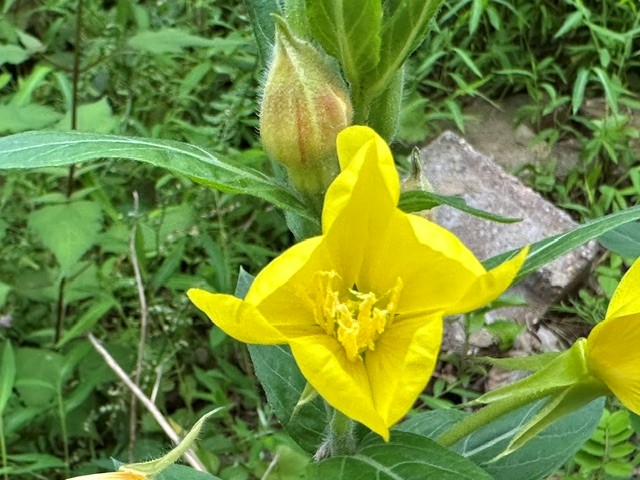
Evening primrose, a native plant that has adapted to fields and roadsides, is a lovely night-blooming biennial.
June through September, the common evening primrose (or Oenothera biennis) will open its yellow petals in the night and then close them by noon the next day. Some botanists theorize that the bright yellow of the flowers acts as a light to attract their main pollinators, moths.
The nectar-producing plant draws many types of moths, including hawk moths, sphinx moths and the pink night moth. Caterpillars of moths will make use of the evening primrose by consuming the leaves and in addition to being a nectar source for adult moths, they will make use of the shelter provided when the petals close during the daytime.
Once pollinated, the average plant produces 6,000 seeds. Goldfinch, the New Jersey state bird, love to break open the capsules to eat the seeds throughout the fall.
Evening primrose does best on recently disturbed grounds such as along roadsides or vacant lots. It has a few ways of adapting to these sites, where other less hardy flowers would not survive. One way is through a method called “seed bank persistence” where the seed remains dormant for up to 70 years until the soil is disturbed again; then the evening primrose takes advantage of any small patches of light that break through to generate regrowth. Evening primrose is also very drought tolerant, allowing it to survive in nutrient-poor, well-drained soils.
Evening primrose is a typical biennial plant in that its first year of growth is marked by just a low-growing rosette of leaves. During this time, the plant stores energy in its taproot. It’s not until the second year that the plant yields the stalk and flowers, which die shortly after being pollinated.
After all that, the remains of the evening primrose turn brown but stay tall and straight even throughout the winter. This provides a pretty reminder of seasons past and holds the promise of seasons yet to come.
Fun Facts About the Evening Primrose
Evening primrose grows in fields and along roadsides on disturbed soils.
Evening primrose is a biennial with first-year growth being a rosette of leaves and the second year growth being a tall stalk with yellow flowers.
The flowers of evening primrose open at night to attract moths.
Caterpillars use evening primrose leaves as a food source, and as adults they feed on nectar and shelter in the petals during the day.
A single evening primrose can produce up to 6,000 seeds.
Goldfinch love the seeds of evening primrose.
The seeds can remain dormant for decades until conditions are just right to emerge.

Jennifer has a Masters in Parks and Resource Management from Slippery Rock University. She worked as a Park Naturalist for Hunterdon County Park System from 2003-2006 and then at the NJSOC full-time from 2006 - 2020, starting as the Program Coordinator and evolving to an Environmental Educator. Jen is a New Jersey native and has lived in Warren County with her family since 2004. She is excited to be offering programs to this community she has grown to love.
- Jennifer Correa-Kruegel, Warren County Naturalisthttps://ridgeviewecho.com/author/jennifer-correa-kruegel-warren-county-naturalist/

- Jennifer Correa-Kruegel, Warren County Naturalisthttps://ridgeviewecho.com/author/jennifer-correa-kruegel-warren-county-naturalist/
- Jennifer Correa-Kruegel, Warren County Naturalisthttps://ridgeviewecho.com/author/jennifer-correa-kruegel-warren-county-naturalist/

- Jennifer Correa-Kruegel, Warren County Naturalisthttps://ridgeviewecho.com/author/jennifer-correa-kruegel-warren-county-naturalist/

