

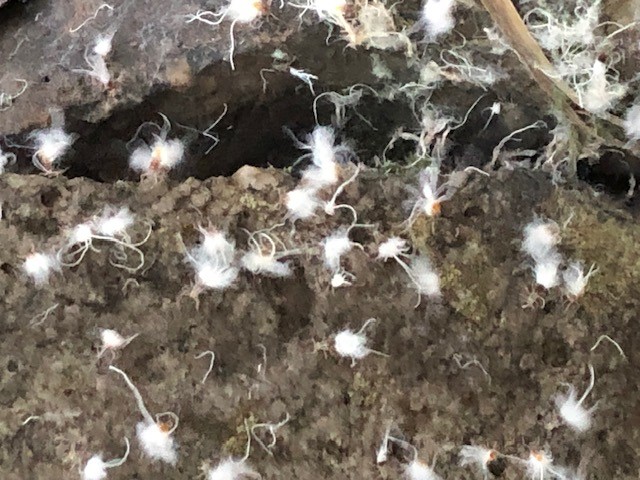
Beech blight aphids are a type of woolly aphid species found on beech trees throughout the east coast of the United States.
Although beech blight aphids (aka Grylloprophillu tesselatus) are not very common, when they are found, they are in large masses on beech trees, branches and leaves.
They can be found as early as July in our forests, however, they are most commonly observed in September through October.
Beech blight aphids have straw-like mouth parts that feed on beech trees by sucking the sap from the branches they are clinging to. Although aphids are typically associated with killing their hosts, beech blight aphids do minimal damage to beech trees. If there are enough aphids, they can kill the branches, but the rest of the tree is left intact. It’s important to note that beech leaf disease is a separate, unrelated ailment from the beech blight aphid.
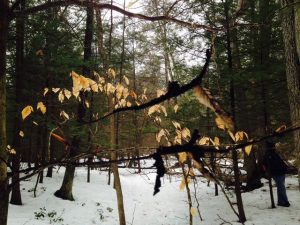
At first sighting of these aphids clustered together, it can appear as snow. Closer inspection, and by potentially breathing on them, will cause the aphids to all start moving up and down at the same time. This gives predators, like the harvester butterfly caterpillar and certain warbler species, the illusion that they are all one unit and much larger than they actually are.
Their “dance” has given them an alternative common name, the “boogie woogie aphid.” They will also sting or bite to protect themselves if they feel threatened.
In addition to “dancing” and stinging or biting, the beech blight aphid will excrete a honeydew made from the tree sap they consumed. The sweet honeydew attracts ants who collect it for their nests.
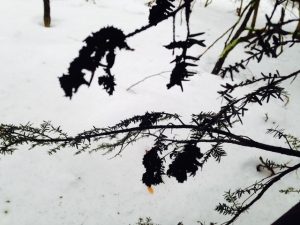
The honeydew that isn’t collected by ants will fall onto the branches below, coating them with the sticky substance. This creates the perfect place to colonize sooty mold. Sooty mold looks like a black, fuzzy blanket covering the branches and can be seen throughout winter, long after the beech blight aphids have retreated to the roots of trees for the season.
Fun Facts About the Beech Blight Aphid
- Beech blight aphids look like snow on the branches of beech trees.
- Predators of the beech blight aphid include the harvester butterfly caterpillar and certain warbler species.
- Beech blight aphids move up and down when they are disturbed given them the alternative name, the “boogie woogie aphid.”
- They also secrete a honeydew that attracts ants and sticks to branches below.
- This honeydew also attracts sooty mold that covers the branches and can be seen throughout the winter.
- Beech blight aphids spend their winter’s underground, on the roots of trees.

Jennifer has a Masters in Parks and Resource Management from Slippery Rock University. She worked as a Park Naturalist for Hunterdon County Park System from 2003-2006 and then at the NJSOC full-time from 2006 - 2020, starting as the Program Coordinator and evolving to an Environmental Educator. Jen is a New Jersey native and has lived in Warren County with her family since 2004. She is excited to be offering programs to this community she has grown to love.
- Jennifer Correa-Kruegel, Warren County Naturalisthttps://ridgeviewecho.com/author/jennifer-correa-kruegel-warren-county-naturalist/
- Jennifer Correa-Kruegel, Warren County Naturalisthttps://ridgeviewecho.com/author/jennifer-correa-kruegel-warren-county-naturalist/

- Jennifer Correa-Kruegel, Warren County Naturalisthttps://ridgeviewecho.com/author/jennifer-correa-kruegel-warren-county-naturalist/

- Jennifer Correa-Kruegel, Warren County Naturalisthttps://ridgeviewecho.com/author/jennifer-correa-kruegel-warren-county-naturalist/

