


You may not know beech trees by name, but many people would recognize their smooth, sturdy trunks or the distinctive, nutrient-dense nuts they drop in the fall. You may have even spotted bear claw marks scarring their otherwise uniform trunks. The American beech is a cornerstone of our local forests, providing essential habitat and food for a wide range of species. In addition to our native beech, you might also notice ornamental, non-native varieties planted in parks and yards.
Unfortunately, all species of beech are susceptible to Beech Leaf Disease (BLD), an ailment caused by a nematode that feeds inside the leaf buds of the tree. While this may sound nonconsequential for a large tree, the disease is oftentimes deadly. These infestations hinder the trees’ ability to photosynthesize, essentially starving them. The leaves from the diseased branches will drop prematurely, and in some cases the tree will die. While saplings with BLD may die within a year or two, mature trees are likely to die within seven to 10 years.
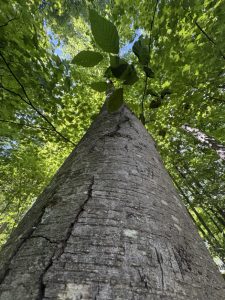
To determine if a tree has BLD, just take a look at the leaves. Normally, in the spring and summer months beech leaves are soft and green. A tree with BLD will have withering, dry, discolored leaves with dark green, yellow or brown coloration between the veins. Not all the leaves on a tree may present the symptoms of BLD, as nematodes may be present in some branches, but not others.
As many of us are still coping with the effects of the emerald ash borer in the form of dead ash trees looming above our roofs, BLD presents yet another major threat to both our local forest ecology and homeowners, who may happen to have a large beech tree in their yard. While BLD is a cause for concern, do not preemptively cut down a beech tree! Some may possess a level of natural immunity to BLD, and cutting down trees preemptively will only guarantee their demise. There are also some treatment options available, although no cure has yet been identified.
Beech trees provide nesting sites and supply nutritious nuts for wildlife, including birds, black bears, opossums and deer, to name just a few. Their nuts are especially rich in fat and protein, making them an important seasonal food source. As beech trees decline, not only does the availability of these nuts diminish, but the forest’s structure also changes. With a reduction in beech canopies, more light reaches the forest floor, altering humidity and moisture levels in the understory. These shifting conditions create new opportunities for other species, native or non-native, to move in and reshape the ecosystem.
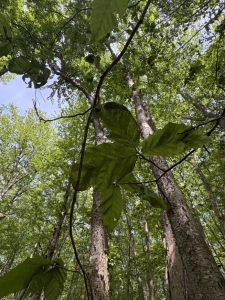
Beech trees are a significant presence in our forests of northern New Jersey. Their smooth, pale trunks seemingly glow against a backdrop of rugged oak, maple, birch and hickory. While BLD does not spell the end for our beloved trees, it is a major threat that requires further research and monitoring efforts.
Next time you find yourself in the woods, take some time to appreciate the large looming beech tree you may find before you or the stands of beech saplings sprouting towards the sunlight. These trees play a major role in our local ecosystem and are more than worthy of our care and appreciation. Our forests would not have the same character they do without the beech tree.
