

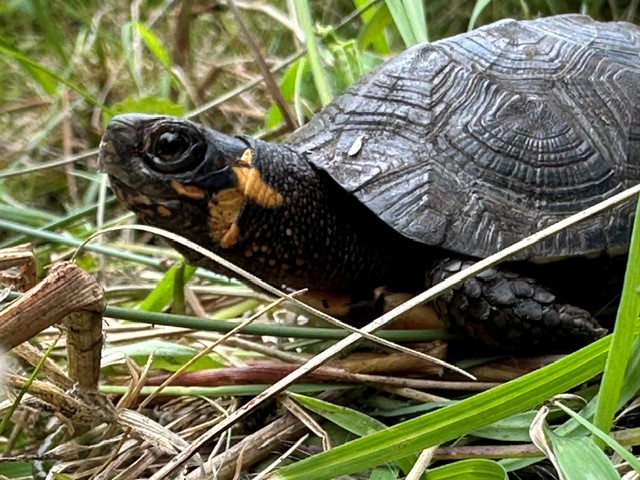
Did you know NJ has an official state reptile? It is the state endangered bog turtle (Glyptemys muhlenbergii), and it was designated as our state turtle in June of 2018 after an elementary school nominated the animal to bring awareness and inspire its conservation efforts. It is also considered federally threatened—meaning it is an animal that is likely to become endangered in the foreseeable future on a national level—with sporadic populations in NY, PA, MA, MD, DE and VA to extreme northeastern GA.
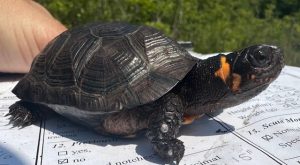
This small elusive turtle has been a victim of habitat destruction, climate change and the pet trade industry (because of its small size), to name a few reasons for its population decline over the last few decades. Bog turtles max out at only 3 to 4.5 inches with a dark domed carapace (top shell) and a yellow splotch behind its eyes on either side.
They tend to hide under sedge tussocks in boggy, wetland habitats. The tops of the sedge tussocks are also used when the turtles lay their eggs. Unfortunately, invasive plant species are outcompeting the native plants that the turtles use, such as rushes, skunk cabbage, cattail, jewelweed and shrubby cinquefoil, as well as reducing the turtles’ nesting and basking sites.
Basking, or allowing the sun to warm them in the early spring, is essential for cold-blooded animals like bog turtles because it cues their biological clocks to trigger them to start eating their diet of invertebrates such as worms, snails, slugs and even some amphibians. They also feed on seeds and berries. Basking also tells them when the best time to mate is, which is usually mid-June to early July. Significant temperature fluctuations from climate change can impact their seasonal cycles that cue them when it is time to mate and lay eggs; it also affects when the plants and animals they feed on will emerge.
The females lay three to four small eggs that hatch around August or September. Bog turtle hatchlings, recently emerged turtles from their eggs, are incredibly tiny (only about an inch long) and are highly susceptible to predation from raccoons, hawks, herons and many others. If a turtle survives this stage, they can possibly live 50 years or more. However, they don’t reach reproductive age until they are between the ages of 8 to 11 years old.
In the late fall, bog turtles will depart to their overwintering sites of underground tunnels premade by other animals or ones the turtles themselves have created. There they will settle in to brumate, or a cold-blooded animal’s version of hibernation.
Conservation efforts include monitoring populations throughout the state on an annual basis, habitat management with a focus on reducing invasive species and strict penalties for taking animals from their habitats.

Biologists will seasonally survey for bog turtles in the early spring, before they have laid their eggs. If a turtle is found, they will process the animal. Processing involves measuring and weighing the animal, estimating the age, marking its carapace to note that it has been found, determining the health of the animal and the insertion of a pit tag, similar to putting a chip in your cat or dog. Sometimes, it’s necessary to take a blood sample from a bog turtle to determine genetic diversity. If there is little genetic diversity in a population, there is a risk of inbreeding and compromising their overall health. Male bog turtles used to travel more frequently to other sites, which would help with diversifying their populations, but that has been made difficult due to habitat fragmentation. Habitat fragmentation is the division of an animal’s habitat through man-made structures such as roads or buildings that inhibit any migrations that may be made.
When bog turtles are captured by biologists, flagging is used to mark where they were found so they can be placed back at their exact location after processing is complete. It is important to place the animal back where it was found since they sometimes have a small home range and can become disoriented when moved away from their area.
If you come across a bog turtle or any of our threatened, endangered, or species of special concern in NJ, please report it to NJ Fish and Wildlife. They have created an app that easily allows you to report sightings of these threatened or endangered species, as well as wildlife of any status observed on roadways.
Jennifer Correa-Kruegel.
Since NJ is such a densely populated state with an extensive system of roadways, it can make it difficult for wildlife to navigate to other suitable habitats to find food, shelter, mates and other resources they need to survive.
According to the NJ Department of Fish and Wildlife, the CHANJ Project: Connecting Habitat Across New Jersey (CHANJ) is an effort to make our landscape and roadways more permeable for terrestrial wildlife by identifying key areas and actions needed to achieve habitat connectivity across the state.
With a little vigilance, the future of the bog turtle may be a little more secure.
Fun Facts About the Bog Turtle
- Bog turtles are the official NJ state reptile.
- Bog turtles are federally threatened and are a state endangered species.
- Their populations are on the decline due to habitat loss, pet trade industry and climate change.
- Bog turtles eat worms, snails, slugs, amphibians, certain invertebrates, and seeds and berries.
- Female bog turtles lay three to four eggs in mid-June that hatch around August or September.
- Brumation is the cold-blooded animals’ version of hibernation.
- Biologists monitor populations throughout the state to determine what protections need to be in place for the animals.
- Citizens are encouraged to report any wildlife sightings to NJDEP-Fish and Wildlife.

Jennifer has a Masters in Parks and Resource Management from Slippery Rock University. She worked as a Park Naturalist for Hunterdon County Park System from 2003-2006 and then at the NJSOC full-time from 2006 - 2020, starting as the Program Coordinator and evolving to an Environmental Educator. Jen is a New Jersey native and has lived in Warren County with her family since 2004. She is excited to be offering programs to this community she has grown to love.
- Jennifer Correa-Kruegel, Warren County Naturalisthttps://ridgeviewecho.com/author/jennifer-correa-kruegel-warren-county-naturalist/
- Jennifer Correa-Kruegel, Warren County Naturalisthttps://ridgeviewecho.com/author/jennifer-correa-kruegel-warren-county-naturalist/
- Jennifer Correa-Kruegel, Warren County Naturalisthttps://ridgeviewecho.com/author/jennifer-correa-kruegel-warren-county-naturalist/

- Jennifer Correa-Kruegel, Warren County Naturalisthttps://ridgeviewecho.com/author/jennifer-correa-kruegel-warren-county-naturalist/

