


It all began about a decade ago with some policy talk about mosquitos, some casual chat about jobs and an understanding of the region’s unique air space.
Ed Smith, a local businessman and at the time a county freeholder or commissioner, was hoping to find a cheaper solution to mosquito infestation in Warren County when he came across the idea of using drones to monitor and spray them. About the same time, a conversation with a friend included a discussion about the need for skills training in the county—and the potential for students learning about drone flight and maintenance.
As a pilot, Smith also knew that the Warren County area was one of the few in the region with uncontrolled air space that would easily allow for drone flight training.
“It then was clear to me that this technology was going to be used in a wide range of applications and that professionals would be needed—and we could train them here. I had been on the board of trustees at Warren County Community College and began talking with college President Will Austin about the idea.”
WCCC’s UAS Program Takes Flight
That program for unmanned aircraft systems (UAS), which started with one drone and a handful of part-time students, is now known as WarrenUAS. It is housed in two state-of-the-art facilities (one of which is named for Smith and his wife) and enrolls about 85 students each year, accessing the program’s more than 90 sophisticated unmanned systems.
It has grown to prepare drone pilots, UAS system programmers, and maintenance professionals for high-paying work in sectors ranging from public transportation, utilities, defense and law enforcement to environmental studies, real estate, event photography and film. The program has added specialties in precision agriculture and, most recently, counter-UAS, which trains students to understand and combat threats from illicit drone activity.
“It is amazing what Will and his team have accomplished,” Smith said. “We see now that drones are entering every facet of our lives. They are entirely changing warfare, for instance.”
Austin, who took a sabbatical from his position as president to jump-start the program, praises Smith for his foresight and his own staff for the hard work in building a program from the ground up.
“Ed saw this as a way a rural college could develop a unique program for residents and local high school grads that could provide a real pathway at the associates level to high-paying incomes,” he said. “We now have a nationally-recognized program with wide-ranging flexibility for students interested in this field.”
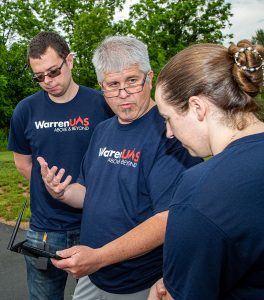
Pete Miller was one of the first four students in the program, entering it from a career in communications, and now has the title chief pilot at WarrenUAS and oversees much of the program.
“Drones are being used in nearly every sector of the economy, and they are going to be utilized in ways we haven’t even thought of yet,” he said. “Our goal from the start was to provide students a pathway into this exciting field with the best equipment, with instructors having current, real-world knowledge and experience and with a curriculum that gives them a well-rounded education about drones and prepares them for the growing number of high-paying positions in the field.
Drone Use Only Continues to Grow
Research suggests that the drone market will more than double over the next decade, and the Federal Aviation Administration notes that drones are increasingly considered a necessity. Warren has kept up, developing the 6,000-sq.-ft., state-of-the-art Edward J. and Eileen Smith Drone Lab and an outdoor multi-function flight training center.
The program offers one-year certificates in Drone Piloting or Maintenance and Repair and two-year associate degrees with concentrations in various areas. There is also an associates in science for those looking to transfer, including a seamless transfer to Embry-Riddle Aeronautical University, one of the top aeronautics schools in the country.
Elsewhere at the college, a new Applied Robotics and Artificial Intelligence Associate of Science degree program to be offered beginning next fall integrates robotics, mechatronics, automation, manufacturing and AI into a 60-credit program.
WarrenUAS also has rare certification to offer top level drone training and to fly drones in a variety or circumstances that require hard-to-get Federal Aviation Administration approval.
“We also have a solid, well-trained and highly educated full-time instructional staff, coupled with experienced part-time adjuncts who are leaders in the UAS field,” Miller said.
Other Innovative Ways to Use Drones
Warren was one of the first programs to offer specialized training in how drones can be used in agriculture to monitor farmland and treat the land efficiently and in more sustainable ways, collaborating with local farmers.
The program also has a non-credit training division for law enforcement, energy, agriculture, wildlife management, and other corporate entities, Miller noted, “So, as students progress through the degree, they have the opportunity to participate in these projects, gaining real-world practical experience and growing their professional networks.”
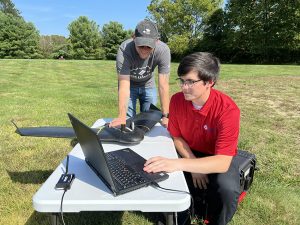
It has beefed up its training for emergency services since drones are increasingly used in search and rescue, criminal investigations and firefighting. The Phillipsburg Police chief recently noted that 10 of his officers will receive training at WarrenUAS.
The program has been involved in a number of efforts to evaluate environmental threats, including work to assess bodies of water and the impact of invasive species. In a student-involved project, WarrenUAS is also working with a state fish & wildlife team to integrate drone technology into their annual deer population counts by utilizing drone-mounted thermal imaging.
The Meadowlands Research and Restoration Institute last winter collaborated with WarrenUAS to map a large wildlife management area near the Hackensack River in Lyndhurst.
One Program, Many Paths to Success
Edward Beckendorf, soon after graduation from WarrenUAS, took a position with a large water utility, inspecting its infrastructure and even flying a drone along water supplies upstream and directing the drone to collect samples. He was excited to come to Warren but uncertain about what career path he would take.
“The drone program just seemed like a good fit, but I didn’t have an idea where it would lead me – and certainly didn’t imagine the work I’d be doing now,” says Beckendorf, who graduated from the WarrenUAS drone training program in 2022.
Another recent graduate, Amy Rodriguez, decided to take a condensed weekend class about drone flight with her son at WarrenUAS, just hoping to find something the two could do together. But instead, she got hooked—enrolled full-time and pursued a degree. Now she has moved on from a successful career in business to become a flight engineer for a growing company exploring the latest uses for uncrewed aircraft.
“It just clicked with me,” says Rodriguez, who had a career in real estate and other businesses and raised twin sons. “There was something about this technology – and the opportunities at Warren – that was so engaging.”
Tom Knibbs was working in sales when he got laid off as the COVID-19 pandemic wore on.
“I saw an ad about WarrenUAS and their drone-training program,” Knibbs says. “And it seemed like it was something that was right up my alley.” That led Knibbs to enroll at WarrenUAS then move from an internship into a full-time job with the New Jersey Transit Authority, where he and two other Warren graduates now make up the utility’s growing drone team.
They use drones to inspect rail lines and the nearby areas for damage that could impact the trains and to inspect other equipment such as huge communications towers. They have also been brought in to inspect and 3D model historic stations that the system would like to refurbish.
The precision agriculture program paid off for Adam Mackey, who graduates this spring and has already started his own small business to help farmers assess and treat their land using drones.
There are more plans to expand the program to meet the needs in a range of fields.
“The goal of Warren over the next five years is to expand our degree concentrations, currently with counter-UAS because it is so timely and in great demand by law enforcement and security services. But we also intend to build out our maritime operations curriculum… This would cover both maritime surface craft as well as submersibles. It will include operational knowledge, hands-on practical pilot training, regulations, and a globally recognized pilot certification,” Miller said.
“There are great opportunities now for our students—and those opportunities are growing.”
