

Let’s talk about my favorite animal: turtles.
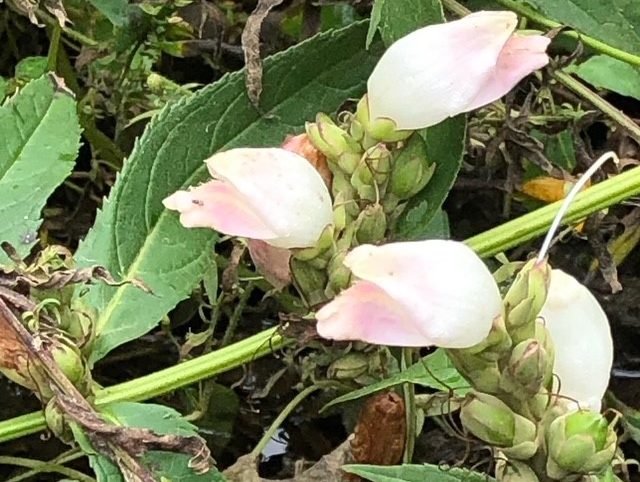
I have been privileged to find many different types of them in my travels and on various job sites I’ve worked as a naturalist. However, there is one type of turtle that has managed to elude me for years, and it wasn’t the animal, but instead a plant. . . the native white turtlehead plant, or the Chelone glabra. The Greek word, “chelone” translates to “tortoise.”
The first time I came across a white turtlehead plant was in its preferred habitat along a stream at Florence Kuipers County Park. It was August 2021, and I was just starting my career with the county. I saw the siting as a good omen for the future of our county parks.
The turtlehead is so-named for the shape of the flower, which appears to be completely closed and impenetrable.
However, turtleheads are pollinated by large bees, who need to squeeze through the tightly closed flower petals and wriggle around to get to the nectar stores, collecting pollen grains on their fuzzy bodies as they go. The female part of the flower (the pistil) opens wider than the male parts (the stamen), making it easier for the pollen to deposit onto the pistil and pollinate due to the bees’ activity.
In addition to providing nectar to eager bees, white turtleheads also serve as the host for the Baltimore checkerspot butterfly, which is a species of special concern in New Jersey. As a host plant, Chelone glabra provides food, shelter and/ or a breeding ground, which is often crucial for the survival of a species.
So, remember: If you spot a turtlehead plant, a Baltimore checkerspot butterfly will not be far away.
You can catch turtleheads in bloom between August through September.
Fun Facts About the Turtlehead
- Turtlehead plants bloom August through September along streams.
- The Greek word, “chelone” translates to “tortoise” in reference to the shape of the flower petals.
- Large bees that are willing to squeeze into the tightly closed flower to collect nectar are the main pollinators for turtleheads.
- Baltimore checkerspot butterflies use the turtlehead plant’s leaves as a host plant for their larvae.

Jennifer has a Masters in Parks and Resource Management from Slippery Rock University. She worked as a Park Naturalist for Hunterdon County Park System from 2003-2006 and then at the NJSOC full-time from 2006 - 2020, starting as the Program Coordinator and evolving to an Environmental Educator. Jen is a New Jersey native and has lived in Warren County with her family since 2004. She is excited to be offering programs to this community she has grown to love.
- Jennifer Correa-Kruegel, Warren County Naturalisthttps://ridgeviewecho.com/author/jennifer-correa-kruegel-warren-county-naturalist/
- Jennifer Correa-Kruegel, Warren County Naturalisthttps://ridgeviewecho.com/author/jennifer-correa-kruegel-warren-county-naturalist/
- Jennifer Correa-Kruegel, Warren County Naturalisthttps://ridgeviewecho.com/author/jennifer-correa-kruegel-warren-county-naturalist/

- Jennifer Correa-Kruegel, Warren County Naturalisthttps://ridgeviewecho.com/author/jennifer-correa-kruegel-warren-county-naturalist/

