

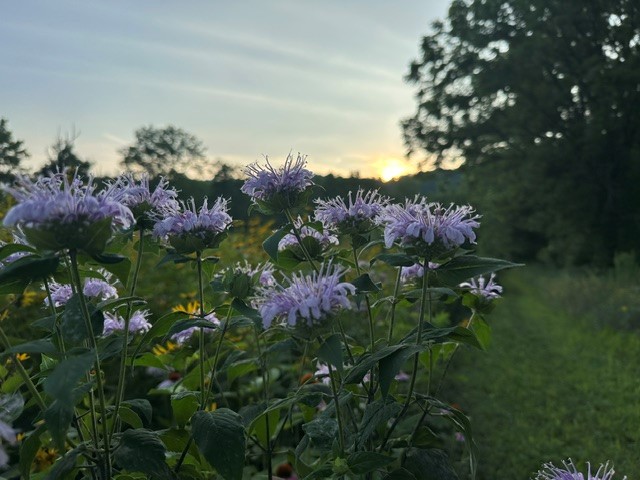
Wild bergamot (Monarda fistulosa) is a native and unusually showy mint plant that can reach heights of up to five feet tall.
Most members of the mint family do not typically grow so high or boast the large colorful flowers that make wild bergamot so unique.
The tubular purple flowers of the wild bergamot bloom from June through September. The wildflower is sometimes confused with bee balm, which looks similar but has red flowers.
The scientific name, Monarda fistulosa is, in part, named after botanist Nicolas Monardes of Spain. Fistulosa is then translated to “full of pipes,” which is a descriptive phrase for the grouping of 20 to 30 individual florets that make up the attractive flowerhead of the bergamot and give it the appearance of a set of organ pipes.

Monarda fistulosa thrives in fields and upland woods but will adapt well to dry fields and dense thickets as well. The plant can be found throughout the northeast but prefers regions that are rich in limestone. Limestone is full of calcium carbonate, which helps neutralize acidic soils, making them a better habitat for crops and plants. The enriched soil that wild bergamot loves also aids in diversifying the overall habitat.
Wild bergamot plants are easily transplanted and naturally add a number of benefits to your own yard. One, the horn-shaped flowers are a perfect source of nectar for pollinator species like bees and butterflies, and they are especially suited for hummingbirds, as the petals seem to be specifically designed for the long beaks of the fast-flying little pollinator.
Additionally, the leaves of wild bergamot, with its minty origins, have been used to treat respiratory illnesses through making an herbal tea or essential oils derived from the plant’s leaves.
Bergamot is an excellent native plant to include in your gardens as it brings an intense pop of color, attracts many pollinator species, and can even be used as a seasoning in food and recipes.
Fun Facts About Wild Bergamot
- Wild bergamot adapts to dry fields and thickets and can be found throughout the northeast in limestone regions.
- Wild bergamot is part of the mint family and if you pluck a leaf and smell it, it has a distinct minty smell.
- You can transplant wild bergamot into your own garden to attract a number of pollinators.
- Wild bergamot blooms June through September.
- The part of the scientific name, fistulosa is translated to “full of pipes” to describe the florets on the flower of wild bergamot.

Jennifer has a Masters in Parks and Resource Management from Slippery Rock University. She worked as a Park Naturalist for Hunterdon County Park System from 2003-2006 and then at the NJSOC full-time from 2006 - 2020, starting as the Program Coordinator and evolving to an Environmental Educator. Jen is a New Jersey native and has lived in Warren County with her family since 2004. She is excited to be offering programs to this community she has grown to love.
- Jennifer Correa-Kruegel, Warren County Naturalisthttps://ridgeviewecho.com/author/jennifer-correa-kruegel-warren-county-naturalist/
- Jennifer Correa-Kruegel, Warren County Naturalisthttps://ridgeviewecho.com/author/jennifer-correa-kruegel-warren-county-naturalist/
- Jennifer Correa-Kruegel, Warren County Naturalisthttps://ridgeviewecho.com/author/jennifer-correa-kruegel-warren-county-naturalist/

- Jennifer Correa-Kruegel, Warren County Naturalisthttps://ridgeviewecho.com/author/jennifer-correa-kruegel-warren-county-naturalist/

