

Most people don’t get a warm, cuddly feeling when they think of a dusty, powdery moth. Especially when compared to beautiful frolicking butterflies. Moths are the night dwellers, with dark wings and fuzzy bodies, who dive in a frenzy at your outdoor lamps and silently nibble on the clothes in your closet. However there are some moths that fly in the face of these stereotypes and can even be quite a beautiful sight.
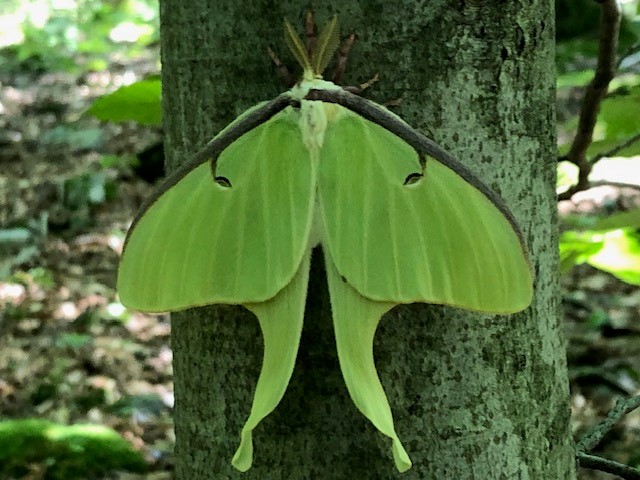
Enter the luna moth, or the Actias luna. The luna moth may look familiar from the commercials for the sleep aid Lunesta. In the ads, the animated, light-green moth stands out brilliantly against the night sky as it flutters gently across the screen.
This real-life beauty is a member of the giant silkworm family, which is a classification of large moths with striking colors and distinct eye-like patterns on their wings.
The males of the species have longer “tails” at the ends of their forewings then the females, and they have larger antennae, too. While both male and female luna moths can fly, the female will depend on the release of pheromones to attract a mate to her position.
Their life cycle begins when the adults emerge after overwintering in their cocoon.
Time is of the essence for these moths to mate because the adults only live seven to 10 days. They do not eat anything as adults.
After mating, the female will lay 200 to 400 eggs. After about seven to 14 days, her eggs will hatch, and the caterpillars will go on to eat deciduous trees such as alder, beech, cherry, hazelnut, hickory and willow.
They will molt, or shed their skin, as they grow, in what is known as “instar stages,” and they will molt about five times over the course of four to 10 days before forming their cocoon.
During the summer months, they will stay in their cocoon for only about two weeks before emerging as an adult and beginning the life cycle all over again.
September/October is when the last cycle of moths have reached the cocoon stage. This generation will stay in there over several months until the following spring.
Some natural predators of the luna moth include owls, bats, hornets and parasitic wasps. However, one major reason for their population decline is the use of herbicides and pesticides on lawns.
If you wish to see more moths in your yard, plant native trees and shrubs that they enjoy eating as caterpillars and avoid using chemicals that can inadvertently harm them.
Fun Facts About the Luna Moth
- Luna moths are from the giant silkworm moth family.
- Their wings are meant to look like giant eyes to a predator.
- The males of the luna moths have larger antennae and longer “tails” at the end of their wings.
- Luna moths overwinter as cocoons and only live for seven to 10 days after emerging.
- Adult luna moths do not eat or drink anything: They search for a mate, lay their eggs, and then die.
- Luna moth caterpillars like to feed on deciduous trees such as alder, beech, cherry, hazelnut, hickory and willow.
- Female luna moths can lay up to 400 eggs.
- Predators of the luna moth include owls, bats, hornets and parasitic wasps.
- Luna moths are on the decline due to pesticide use.

Jennifer has a Masters in Parks and Resource Management from Slippery Rock University. She worked as a Park Naturalist for Hunterdon County Park System from 2003-2006 and then at the NJSOC full-time from 2006 - 2020, starting as the Program Coordinator and evolving to an Environmental Educator. Jen is a New Jersey native and has lived in Warren County with her family since 2004. She is excited to be offering programs to this community she has grown to love.
- Jennifer Correa-Kruegel, Warren County Naturalisthttps://ridgeviewecho.com/author/jennifer-correa-kruegel-warren-county-naturalist/
- Jennifer Correa-Kruegel, Warren County Naturalisthttps://ridgeviewecho.com/author/jennifer-correa-kruegel-warren-county-naturalist/
- Jennifer Correa-Kruegel, Warren County Naturalisthttps://ridgeviewecho.com/author/jennifer-correa-kruegel-warren-county-naturalist/

- Jennifer Correa-Kruegel, Warren County Naturalisthttps://ridgeviewecho.com/author/jennifer-correa-kruegel-warren-county-naturalist/

