

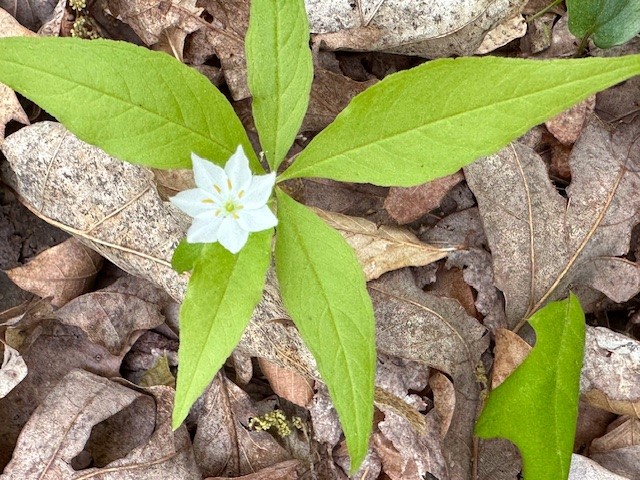
North American Starflower (Trientalis borealis) is a subtle, lovely native spring bloom. Subtle because the Latin translation “Trientalis” means “one third of a foot” in reference to the average height of the plant. “Borealis” means “north” and is where the plant is commonly found.
The whorled shiny green leaves make the seven, white, pointed petals stand out in the deciduous and coniferous forests where it resides. Once pollinated by bees, starflower will lose its leaves around midsummer leaving behind the stalk and one to two seeds.
The seeds need to endure a few years of cold seasons before they are able to germinate. This is known as cold stratification. High soil acidity and shade can help establish this plant after the seeds go through cold stratification. Starflowers are also able to spread through an extensive underground root network, called rhizomes.
Due to its small size—only about four to nine inches—and short bloom time of May and June, starflower is not often added to local gardens. However, it is deer-resistant, shade-prefered and native. If you wish to plant starflower in your garden, it’s best to collect the seeds that are pale pink when they are ripe.
The berries and seeds of the starflower are often eaten by small rodents like chipmunks and mice, or ground-feeding birds like thrushes and sparrows. Pollinators also enjoy the North American starflower.
Starflower found in our woods can be an indicator of forest health and climate change. Naturalists are monitoring the earlier flowering times of the starflower plant and how it relates to the warming temperatures in our area.
Observing even the smallest of our species can tell us so much about our environmental health. After all, if there is something impacting our environment, it is most likely impacting people, too.
Fun Facts About the North American Starflower
- The Latin word for North American starflower, “Trientalis”, refers to the small size of the plant.
- The second part of the Latin name, “Borealis”, refers to where the plant is commonly found, in the north.
- North American starflower is deer-resistant, shade-tolerant and a native plant that is often overlooked for gardens due to its small size.
- The whorled leaves help the seven petals of the flower stand out.
- North American starflower prefers soil with high acidity.
- Pollinators and wildlife value the flower for its pollen and seeds.
- By observing the bloom timing of the North American starflower, naturalists can learn about our forest health and study the effects of a warming climate on the natural world.

Jennifer has a Masters in Parks and Resource Management from Slippery Rock University. She worked as a Park Naturalist for Hunterdon County Park System from 2003-2006 and then at the NJSOC full-time from 2006 - 2020, starting as the Program Coordinator and evolving to an Environmental Educator. Jen is a New Jersey native and has lived in Warren County with her family since 2004. She is excited to be offering programs to this community she has grown to love.
- Jennifer Correa-Kruegel, Warren County Naturalisthttps://ridgeviewecho.com/author/jennifer-correa-kruegel-warren-county-naturalist/
- Jennifer Correa-Kruegel, Warren County Naturalisthttps://ridgeviewecho.com/author/jennifer-correa-kruegel-warren-county-naturalist/
- Jennifer Correa-Kruegel, Warren County Naturalisthttps://ridgeviewecho.com/author/jennifer-correa-kruegel-warren-county-naturalist/

- Jennifer Correa-Kruegel, Warren County Naturalisthttps://ridgeviewecho.com/author/jennifer-correa-kruegel-warren-county-naturalist/

