

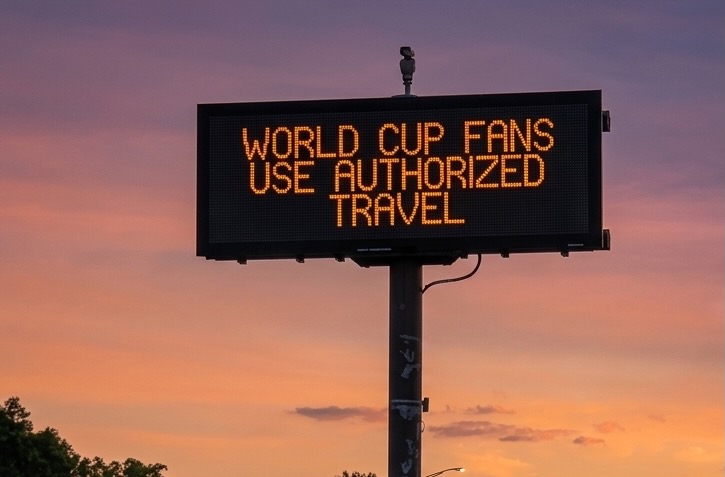
See if you agree with the following statement.
“The words do not exist in any language or dialect that could express how little I care about the World Cup soccer tournament being played in the United States. Or anywhere else for that matter.”
If you don’t agree, please feel free to turn to other sports websites where you can read all about the upcoming spectacle (and how much the American taxpayer is being fleeced by said spectacle).
If you do agree, please read on.
“How do you really feel about this, Phalon?!?” you might ask.
Allow me to explain. It may sound heretical to sneer at this blessing that has been bestowed upon North America by FIFA, the International Federation of Football, perhaps the most corrupt sports organization since the Roman Federation of Gladiators. But I know I am not alone.
And just for a bit of clarification, when I say “soccer,” I am referring to the game the rest of the world calls “football.” Here, “football” means the game with helmets, pigskin and gridiron. There will be no need to qualify the term as “American football.”
I have nothing against soccer. It’s a great game, especially for a sports photographer, where unlike football or baseball, there is constant action, which makes it easy to get great shots often in just the first few minutes, allowing for a quick exit.
For the same reasons, kids get a lot more exercise in soccer. Whereas Little League is a lot of standing around and waiting between bursts of action, all the kids are in motion during a soccer game.
Soccer has even become a major Division 1 college sport. But a national pastime? Despite many efforts, soccer has just never caught on with the American masses.
Soccer is like the metric system in the U.S. We tried it. Nobody wanted it. We tried it a second time. Nobody wanted it a second time.
We brought Pelé, perhaps the greatest soccer player of all time, to the New York Cosmos in the 1970s. People came to see him, but curiosity satisfied, they quickly disappeared. So did the Cosmos.
The World Cup actually came to the United States in 1994. You may not even remember it. You may not have been born yet. A friend of mine was an editor at a soccer magazine at the time. We had numerous soccer vs. baseball debates. An Englishman, he thought baseball was a lot of standing around.
And it is. But I was able to get him to appreciate the nuances of the game. The battle of wits between a batter and pitcher. The turn of a shortstop throwing to first. And I looked at soccer the same way.
I still didn’t get it. To me soccer was a bunch of people kicking a ball around until the goalie wasn’t paying attention and the ball seemed to just randomly land in the net.
It’s not that American sports fans lack passion. We have it by the bagful. But fans in soccer nations take it to another level. You’ve probably heard the phrase “Kill the ump!” Just hyperbole.
In some soccer circles, not so much. In 2013, 20-year-old Otávio Jordão da Silva Cantanhede was officiating a league game in Brazil. He ejected a player who then refused to leave the field. So, da Silva did what any reasonable referee would do and stabbed the player to death.
The home crowd was not happy with this development and converged on the field stoning da Silva to death, decapitating him and placing his head on a pike in the middle of the field. That’s fan devotion. In the U.S. we generally only pull down goal posts and set police cars on fire.
I don’t expect any major misbehavior by New Jerseyans, even when post mortems of the event start revealing massive losses and deceptive bookkeeping that will leave state, county and local governments in debt for millions while FIFA walks away with billions. Even as corporate and government officials, fresh from basking in the glory of luxury suites and free parking, are shocked—shocked—that taxpayers are left holding the bag.
But don’t worry about FIFA. They are expected to net about $11 billion. GOOOAAAALLLL!!!!!

Joe brings decades of journalism experience to the Ridge View Echo, covering everything from local school boards to the U.S. Supreme Court. A former National Law Journal editor and Columbia Law School press officer, he now enjoys telling community stories in Blairstown, where he lives with his wife, Rose, and their two dachshunds.
- Joe Phalon, Contributing Writerhttps://ridgeviewecho.com/author/joe-phalon-contributing-writer/

- Joe Phalon, Contributing Writerhttps://ridgeviewecho.com/author/joe-phalon-contributing-writer/

- Joe Phalon, Contributing Writerhttps://ridgeviewecho.com/author/joe-phalon-contributing-writer/

- Joe Phalon, Contributing Writerhttps://ridgeviewecho.com/author/joe-phalon-contributing-writer/

