

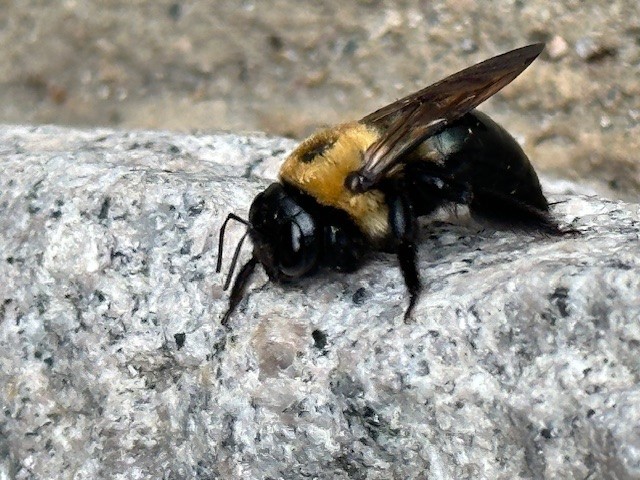
Eastern carpenter bees (Xylocopa virginica) are an important native pollinator species found throughout the eastern United States. According to PennState Extension, “Fifteen percent of our agricultural crops are pollinated by native bees such as carpenter bees.”
Carpenter bees are sometimes confused with other bees such as bumblebees, but the differences between them are easily observed. Bumblebees live in colonies or hives, in a community, where carpenter bees are more solitary. Additionally, carpenter bees have shiny abdomens while bumblebees have fuzzy ones; and, finally, carpenter bees have a distinct black spot on the back of their thorax, right behind their head.
As for the distinctions between male and female, they might be a little more challenging to observe. Male carpenter bees have a white spot on the front of their face where females do not. Additionally, males do not have a stinger but will get territorial with other male carpenter bees and people, if they feel threatened. Females do have the ability to sting, but you need to be harassing them to earn it.
Carpenter bees are so named because they chew holes in wooden fixtures to seek refuge in the winter and lay eggs in the summer. In fact, the Latin word Xylocopa means “woodcutter.” When the females chew out the tunnels for their eggs, they will also make individual chambers for the eggs and enclose it with a packet of pollen for the larvae to consume as it grows and emerges. For the females, the more successful (the more larvae that have reached maturity) the nest that was excavated, the larger it will be over time because they will come back to reuse the same nest year after year.
A carpenter bee’s main diet consists of nectar and pollen, not the wood they excavate, as evidenced by the wood shavings that can be seen outside cavities drilled in the wood. Since they don’t eat the wood, they can be difficult to manage with pesticides. The best remedy would be to stain or paint the wood before they have arrived to create their nests. Another solution is to provide them with attractive alternative housing, such as untreated cedar blocks to lure them away.
Finding ways to coexist with native wildlife is always the best bet for maintaining a healthy environment for everyone. Friendly reminder: Many of the fruits and vegetables we enjoy throughout the seasons have been pollinated by our native insects.
Fun Facts About the Carpenter Bee
- Carpenter bees are more solitary than other species of bees.
- Male carpenter bees have a white spot in front of their face where females do not.
- Female carpenter bees can sting if they are harassed.
- Carpenter bees excavate chambers in wood to lay eggs and overwinter in.
- Carpenter bees consume nectar and pollen, not wood.
- Managing carpenter bees involves staining or painting the wood you do not want used and providing alternative housing.

Jennifer has a Masters in Parks and Resource Management from Slippery Rock University. She worked as a Park Naturalist for Hunterdon County Park System from 2003-2006 and then at the NJSOC full-time from 2006 - 2020, starting as the Program Coordinator and evolving to an Environmental Educator. Jen is a New Jersey native and has lived in Warren County with her family since 2004. She is excited to be offering programs to this community she has grown to love.
- Jennifer Correa-Kruegel, Warren County Naturalisthttps://ridgeviewecho.com/author/jennifer-correa-kruegel-warren-county-naturalist/
- Jennifer Correa-Kruegel, Warren County Naturalisthttps://ridgeviewecho.com/author/jennifer-correa-kruegel-warren-county-naturalist/
- Jennifer Correa-Kruegel, Warren County Naturalisthttps://ridgeviewecho.com/author/jennifer-correa-kruegel-warren-county-naturalist/

- Jennifer Correa-Kruegel, Warren County Naturalisthttps://ridgeviewecho.com/author/jennifer-correa-kruegel-warren-county-naturalist/

