


Although there are 21 genera in eastern North America, Lady’s Slippers (or Cypripedium) are not a common find in New Jersey forests—so it can indeed be exciting to come across any variation of this orchid.
It can also be very tempting to pluck them. However, in the spirit of leave no trace, visitors are asked not to gather them: In fact, it is actually illegal and harmful in that it can reduce their populations in the future.
Like most orchids, lady’s slippers require specific soil conditions and have a symbiotic relationship with a fungus within the soil in order to thrive. Typically, orchid seeds do not contain the nutrients they need and require the fungus to aid in breaking the seed open. The fungus then attaches to the seed and transfers food that it needs to grow properly.
When the lady’s slipper is established at producing its own resources, the fungus then takes back nutrients through the plant’s root system. It is a long-term relationship between the plant and the fungus that can take many years until the plant reaches maturity. This makes it difficult to transplant the orchid and is all the more reason to leave them where they are. It also makes me think of the old saying, “Adopt the pace of nature, her secret is patience.”
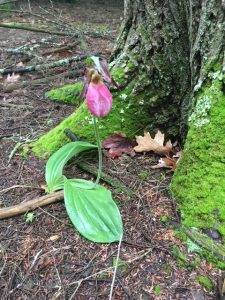
Lady’s slippers can be found in a variety of habitats, anywhere from boggy swamps, to dunes, to dry woods. In my experience, I have found pink lady’s slippers more frequently in the dry woods with a nice layer of pine needles surrounding them or near a decaying log. As an alternative habitat, I had the privilege of coming across a yellow lady’s slipper within a boggy-wet habitat.
Pink lady’s slippers will start off their first year with just basal leaves low on the ground. The following year, if conditions are favorable, the plant will develop its signature blooms that look like a “lady’s slipper.” The Greek name “Cypripedium” similarly translates to Venus’s slipper. Additional names include, “Indian moccasin,” “whippoorwill’s shoe,” “squirrel’s foot,” or even “old goose.”
Although lady’s slippers are named after their appearance, I have often found them solitary and not in the typical pairs. Though not always what you expect, lady’s slippers are always sure to inspire and delight.
Just remember: As with all wildlife in NJ, collect only memories, leave only footprints.

Jennifer has a Masters in Parks and Resource Management from Slippery Rock University. She worked as a Park Naturalist for Hunterdon County Park System from 2003-2006 and then at the NJSOC full-time from 2006 - 2020, starting as the Program Coordinator and evolving to an Environmental Educator. Jen is a New Jersey native and has lived in Warren County with her family since 2004. She is excited to be offering programs to this community she has grown to love.
- Jennifer Correa-Kruegel, Warren County Naturalisthttps://ridgeviewecho.com/author/jennifer-correa-kruegel-warren-county-naturalist/
- Jennifer Correa-Kruegel, Warren County Naturalisthttps://ridgeviewecho.com/author/jennifer-correa-kruegel-warren-county-naturalist/
- Jennifer Correa-Kruegel, Warren County Naturalisthttps://ridgeviewecho.com/author/jennifer-correa-kruegel-warren-county-naturalist/

- Jennifer Correa-Kruegel, Warren County Naturalisthttps://ridgeviewecho.com/author/jennifer-correa-kruegel-warren-county-naturalist/

