

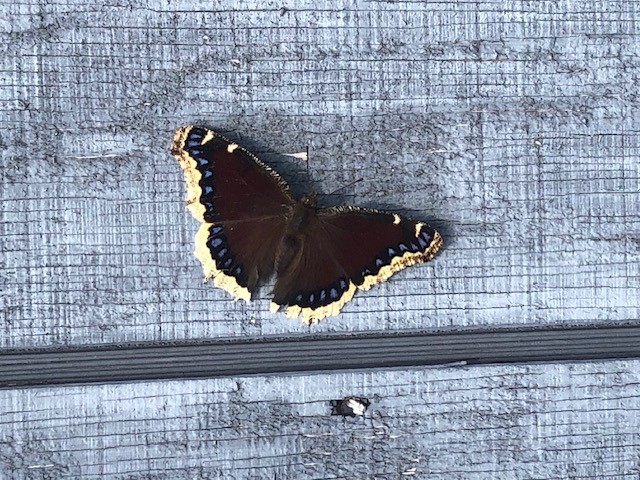
The mourning cloak (Nymphalis antiopa) is one of the earliest-appearing and most recognizable butterflies in northwest New Jersey in the spring. After a long, cold winter spent hiding in the gaps of rocks or bark, the adult butterflies elegantly glide out on a warm day in late winter or early spring. As with many creatures this time of year, they spend their first moments, soaking up the sun and sipping sap or nectar from trees or early spring flowers.
Once they have gained enough energy, they will seek out a mate. The females then lay their eggs on their host plants, usually a willow or poplar tree. After about two weeks, the caterpillars hatch from their eggs, feed on the leaves, and then go through three to four molts before finding a secluded location to form their chrysalis. Once another two weeks have passed, the butterflies emerge from their chrysalises, in late June or early July. The butterfly will remain in a state of torpor, or rest, until the following spring, when it will begin the process all over again.
The mourning cloak has an unmistakable appearance that is not easily confused with any other butterflies. Its dark body and wings cause the yellow border and blue spots to stand out quite distinctly. It is alleged that the name “mourning” cloak is because the wing pattern looks like a shawl that a woman might wear to a funeral.
Despite the dark meaning behind the appearance and name of the mourning cloak butterfly, it is also a traditional harbinger of spring that represents “rebirth” to those looking for new life to emerge after a long, bleak winter.
Fun Facts About the Mourning Cloak Butterfly
- Mourning cloak butterflies are one of the first butterflies to appear in early spring.
- They overwinter as adults in gaps of rocks or trees.
- Their preferred food is willow or poplar.
- They will sip nectar or sap from trees recently tapped by wood peckers.
- The mourning cloak is so named because it looks like a shawl that a woman might wear to a funeral.

Jennifer has a Masters in Parks and Resource Management from Slippery Rock University. She worked as a Park Naturalist for Hunterdon County Park System from 2003-2006 and then at the NJSOC full-time from 2006 - 2020, starting as the Program Coordinator and evolving to an Environmental Educator. Jen is a New Jersey native and has lived in Warren County with her family since 2004. She is excited to be offering programs to this community she has grown to love.
- Jennifer Correa-Kruegel, Warren County Naturalisthttps://ridgeviewecho.com/author/jennifer-correa-kruegel-warren-county-naturalist/
- Jennifer Correa-Kruegel, Warren County Naturalisthttps://ridgeviewecho.com/author/jennifer-correa-kruegel-warren-county-naturalist/
- Jennifer Correa-Kruegel, Warren County Naturalisthttps://ridgeviewecho.com/author/jennifer-correa-kruegel-warren-county-naturalist/

- Jennifer Correa-Kruegel, Warren County Naturalisthttps://ridgeviewecho.com/author/jennifer-correa-kruegel-warren-county-naturalist/

