


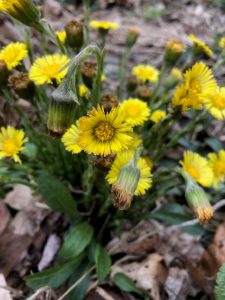
Coltsfoot’s origin story begins in western Europe, northern Asia, and North Africa before it was brought to the United States as an herb. It has become prolific throughout the United States as it is highly adaptable, growing on roadsides, fields, coastal areas, wetlands, farmlands, and more. The coltsfoot in the pictures shown are along roads that get a significant amount of road salt erosion in the wintertime, but these blooms persist.
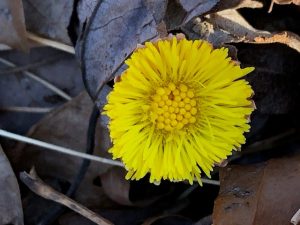
At first glance, coltsfoot (Tussilago farfara) does indeed look just like your typical dandelion, growing in spite of harsh conditions. A closer inspection reveals some key differences.
One, there are no leaves, yet. Two, the stems of coltsfoot are shaggy-like, where dandelion stems are smooth. Finally, there’s the flower itself. Coltsfoot flower blooms in early March with a distinct center that has the thin rays of petals coming from it.
Coltsfoot gets its name because the leaves look like a small horse’s hoof-print. The hoof-shaped leaves are a ground cover in the early summer, after the flowers are done blooming.
If it’s night or cloudy, the flowers close up tight to help conserve heat and energy for when insects will be around to likely pollinate the flower. In the sunlight and warmer spring days, they open as big, beautiful yellow disks, dotting the roadsides in order to attract the early pollinator insects.
However, this plant has the ability to also self-pollinate if need be. The seeds produced are wind-dispersed, just like the dandelion, and they can also spread through underground rhizomes, making this hardy invasive extremely difficult to eradicate.
Sources say that herbivores, or animals that eat plants, like deer and rabbits will nibble on young shoots. However, although the Blairstown area has a number of herbivore species, I have not seen evidence of their consumption, like I have with other blooms, or seen any damage to the overall population of coltsfoot.
Coltsfoot does have a number of medicinal uses. It has been used to treat diarrhea, insect bites, inflammation, and leg ulcers. However, its main use was as a cough suppressant. The Latin word “tussilago” or “tussis” means “cough dispeller” and may sound familiar, in part from the cough medicine, Robitussin.
An extract from the leaves can be made into cough drops, or dried leaves can be steeped as a tea. Take care when consuming coltsfoot medicinally because too much has been shown to cause liver damage.
Fun Facts About Coltsfoot
- Coltsfoot and dandelion look similar at first but are shown to be very different upon a close comparison of the leaves, stem, and the flowers.
- Coltsfoot flowers will close up at night or when it is cloudy to conserve heat and energy.
- Coltsfoot has medicinal uses, in particular for coughs.
- The Latin word “tussilago” means “cough dispeller”.

Jennifer has a Masters in Parks and Resource Management from Slippery Rock University. She worked as a Park Naturalist for Hunterdon County Park System from 2003-2006 and then at the NJSOC full-time from 2006 - 2020, starting as the Program Coordinator and evolving to an Environmental Educator. Jen is a New Jersey native and has lived in Warren County with her family since 2004. She is excited to be offering programs to this community she has grown to love.
- Jennifer Correa-Kruegel, Warren County Naturalisthttps://ridgeviewecho.com/author/jennifer-correa-kruegel-warren-county-naturalist/
- Jennifer Correa-Kruegel, Warren County Naturalisthttps://ridgeviewecho.com/author/jennifer-correa-kruegel-warren-county-naturalist/
- Jennifer Correa-Kruegel, Warren County Naturalisthttps://ridgeviewecho.com/author/jennifer-correa-kruegel-warren-county-naturalist/

- Jennifer Correa-Kruegel, Warren County Naturalisthttps://ridgeviewecho.com/author/jennifer-correa-kruegel-warren-county-naturalist/

