


Not as well-known as some of its more common backyard brethren, the American hornbeam (or Carpinus cardiniana) is a native, deciduous tree in the birch family. The name “hornbeam” is a reference to the very hearty quality of the wood, similar in toughness to an animal’s bony horns.
Hornbeam is a smaller understory tree in New Jersey’s hardwood forests, and it doesn’t grow much bigger than 30 feet. American hornbeam borders the edges of rich wetlands within local forests and is incredibly shade tolerant. Since this tree remains relatively small, the uses of its wood are limited to making smaller items like tool handles.
The American hornbeam’s yellow-green flowers bloom in April or May while the nuts mature in late summer, providing food for grouse and other wildlife. In addition to being good for wildlife, the hornbeam is also very low maintenance and low mess.
But how do you identify a hornbeam without its buds, nuts, or leaves?
Dendrologists, or people who study trees, have other ways to determine which tree is which in the winter. One way to identify trees is by looking to see if they have opposite or alternate branching. In opposite branching, each branch has a symmetrical, opposite branch. If branches are staggered on either side of the main branch, this is an alternate branching tree.
MAD CapHorse is a common mnemonic to remember that Maple, Ash, Dogwoods, and Horse chestnuts have opposite branching. All other trees — including the American hornbeam — have alternate branching.
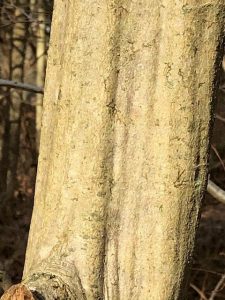
If the branching is too high to determine the placement, you can also identify the American hornbeam tree by looking for its distinctive bark. American hornbeam has a muscle-like look and texture to its bark, which has earned it the nickname of “muscle wood” as an apt alternative.
Fun Facts About the American Hornbeam
- The name “hornbeam” refers to the strong quality of the wood. (Beam means “tree” in Old English.)
- The white wood of the American hornbeam is used to make small items like tool handles.
- American hornbeam can grow up to 30 feet tall and do very well in shady conditions.
- The seeds from American hornbeam provide food for wildlife.
- You can identify American hornbeam by its bark, which has the look of a flexed, taut muscle.

Jennifer has a Masters in Parks and Resource Management from Slippery Rock University. She worked as a Park Naturalist for Hunterdon County Park System from 2003-2006 and then at the NJSOC full-time from 2006 - 2020, starting as the Program Coordinator and evolving to an Environmental Educator. Jen is a New Jersey native and has lived in Warren County with her family since 2004. She is excited to be offering programs to this community she has grown to love.
- Jennifer Correa-Kruegel, Warren County Naturalisthttps://ridgeviewecho.com/author/jennifer-correa-kruegel-warren-county-naturalist/
- Jennifer Correa-Kruegel, Warren County Naturalisthttps://ridgeviewecho.com/author/jennifer-correa-kruegel-warren-county-naturalist/
- Jennifer Correa-Kruegel, Warren County Naturalisthttps://ridgeviewecho.com/author/jennifer-correa-kruegel-warren-county-naturalist/

- Jennifer Correa-Kruegel, Warren County Naturalisthttps://ridgeviewecho.com/author/jennifer-correa-kruegel-warren-county-naturalist/

