


A Familiar Beginning in “The Receptionist”

The man in the opening scene of Centenary Stage Company’s “The Receptionist” wants to tell us about fly fishing. How wholesome — the hobby and the type of man who enjoys that hobby. He sits comfortably in the dad archetype. You get the feeling that he has more than one kid, and all of them know how to change a tire.
All of those soothingly familiar signals, word choices and gestures lull us into a sense that we know who this is. We know what’s happening. What’s that backdrop behind him? An abstract mishmash of grays and reds? Oh, now he’s talking about fishing lures. Pay attention to that instead: the expected, the familiar, the routine you think you know.
By the time the play reaches the end of its slim 75-minute runtime, we understand the lie beneath that sense of familiarity and the trap that was set for us. But by then, the realization comes too late.
A Sharp Office Satire with a Dark Twist
Adam Bock wrote a devilish snare of a play in “The Receptionist,” and Centenary Stage Company knows how to recreate its setting with a smirk and a wink. Once the mysterious backdrop disappears, we find ourselves in the platonic ideal of a corporate office lobby. The usual artifacts are all here: business card holders! Tastefully generic sculptures that probably still have the stubborn remnants of a HomeGoods price sticker stuck to the bottom! A four-cup coffee pot!
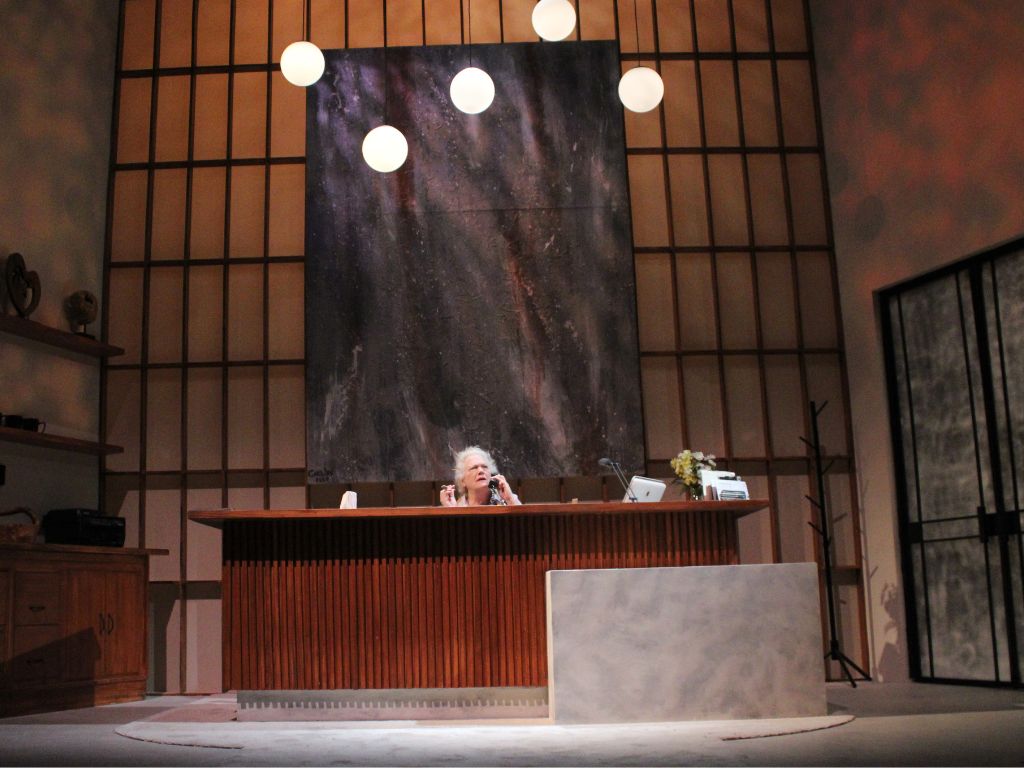
And what would an office environment be without a large-scale abstract painting to unobtrusively cover wall space? Pastel landscapes are the usual preference, but this gray canvas streaked with abstract reds will do. Kudos to set designer Haley E. Wallenfeldt for the clever touch. It’s part punchline, part omen.
Beverly, the Heart of the Office
The play bills itself as a twisty comedy and it feels like that when we first meet the titular receptionist, Beverly. Played commandingly by Mary McLain, Beverly establishes herself as the corporate admin everywoman. She’s the formidable office lady with an iron grip on the file cabinet keys and the office pen supply, who keeps the coffee pot full and the birthday cakes ordered on time.
Beverly is friendly — she greets callers with a practiced customer service voice, and office visitors with boisterous hospitality. She is efficient enough — she routes callers to the correct voice mailbox between bouts of delivering “Mama Bear” romantic advice to her younger coworker Lorrain, played by Gemma Berg. Beverly might make a few innocent errors but, in nearly every circumstance, those tiny slip-ups don’t register.
Most of all, Beverly is nice. Her conversations are effortless, her offers politely generous — you’ll never be in need of a croissant, pastry or bagel when she’s around to get it for you. On the phone, she uses an arsenal of customer service scripts to smooth the friction from every call. The office is her natural habitat and workday banter, with all of its niceties and etiquette, her native tongue.
The Arrival of Mr. Dart
One morning, a young man walks into her office. Mr. Dart, as he introduces himself, seems to know the office-life drill by heart. Played with a mixture of affable charm and a shark’s smile by Christopher J. Young, he joins the office’s social ecosystem with hardly a splash. It’s no surprise; he’s from Central Office, the headquarters of this unnamed company.

We never learn exactly what the company does, though we are given strong hints to conclude that the less we know, the better. The initial hint comes with the return of the fly-fishing father figure from the first scene. We learn that this is Mr. Raymond (played by Eli Ganias who brings a weary warmth), the boss of the Northeast Office. We learn that his workday was interesting yesterday — something about a broken finger — but nobody blinks. Then Mr. Dart finds him, and the situation shifts into something at first confusing, then concerning, and then, finally, horrifying.
When Routine Becomes a Blindfold
As the plot escalates, the purpose of that familiar office banter shifts. Reassuring at first, it cemented the known predictability of this place with its deadening sameness. The banter touched on the same topics, the customer service calls that always end with the same script.

But routine isn’t just a habit. It can be a blindfold, too. People can fool themselves into believing any situation is okay, as long as the coffee and bagels keep coming. The routine itself deadens the senses, lulling conscience and fear into complacency, even as the darkness literally closes in. Hats off to lighting designer, Ed Matthews, for subtly sinister work.
A Chilling Parallel to History
A parallel can be made to Pastor Martin Niemöller’s poem “First They Came,” a favorite on social media of late, which details the gradual onset of violence in Nazi Germany. The “they” in the poem first came for communists, then socialists, trade unionists, Jews, and, finally, for the speaker — but by then, there was no one left to save him.
The play asks the questions: How do you recognize when ‘they’ have arrived…when it’s time to break the spell of routine, and act?
There’s an answer, but not a happy one. You’ll never think they’re coming — until they’re coming for you.
“The Receptionist” plays at Centenary Stage Company in Hackettstown through March 9. For more information or to buy tickets, visit https://www.centenarystageco.org/the-receptionist.

Chip O'Chang is an educator, fiction writer, and lifelong resident of New Jersey. He has also written for My Life Publications and NJ Indy. He lives in the NJ Skylands with his partner, two cats, and and a bearded dragon.
- Chip O'Chang, Contributing Writerhttps://ridgeviewecho.com/author/chip-ochang-contributing-writer/

- Chip O'Chang, Contributing Writerhttps://ridgeviewecho.com/author/chip-ochang-contributing-writer/

- Chip O'Chang, Contributing Writerhttps://ridgeviewecho.com/author/chip-ochang-contributing-writer/

- Chip O'Chang, Contributing Writerhttps://ridgeviewecho.com/author/chip-ochang-contributing-writer/

