


In its Nov. 4 board of education meeting, Blairstown Elementary School revealed the results of its spring 2024 New Jersey Student Learning Assessment (NJSLA). While Superintendent Dr. Patrick Ketch and Principal Colleen Silvestri identified some reasons for celebration, the data also showed some room for improvement.
The NJSLA is administered each spring to schools statewide. While individual student scores are kept confidential, the collective data is used to measure each district’s effectiveness in teaching New Jersey’s learning standards. Grades three through nine are required to take the ELA and math sections, while only grades five, eight and 11 must take the science section.
Student performance on the NJSLA is expressed in two ways. One is by score. The ELA and math sections are graded on a scale from 650 to 850, with 750 defined as the threshold for meeting grade-level expectations.
The other metric for student achievement is performance level. On the ELA and math sections, the NJSLA defines student scores by five performance levels:
Level 1: Not Meeting Expectations (650 – 699)
Level 2: Partially Meeting Expectations (700 – 724)
Level 3: Approached Expectations (725 – 749)
Level 4: Met Expectations (750+)
Level 5: Exceeded Expectations (above 750; varies by grade level and subject)
All districts are required to share the results of their NJSLA spring testing. However, the “Department does not require districts to present data in a specific manner,” according to Laura Fredrick, director of the NJDOE’s Office of Communications.
Blairstown Elementary Shares Student Performance Levels Only
At their respective board meetings, nearby Knowlton Elementary and Frelinghuysen Township School shared their own NJSLA results using average scores by grade and subject, comparing their students’ scores to state averages. Frelinghuysen also included student performance level data alongside scores.
Blairstown Elementary shared its test results using student performance levels only. Superintendent Ketch explained at the start of the NJSLA presentation that this was a choice to “show the difference in growth.”
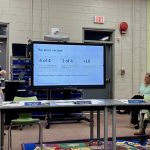
The first slide (shown at top of story) showed an overall summary of Blairstown’s performance levels. Silvestri pointed out two positive differences between spring 2024 results and spring 2023: In spring 2023, 14% of Blairstown’s students fell into the lowest rank on the ELA section, Level 1. In spring 2024, that percentage shrank to 8%. The percentage of students in the lowest performance level of math had also shrunk from 10% in 2023 to 8% in 2024.
“These bottom two, the lightest two shades of purple, those are the ones we want to keep shrinking, and we want to keep increasing the top two thirds of the bars here,” Silvestri said, gesturing to the color blocks for Levels 3 – 5. “So we’re making strides.”
According to the spring 2024 Score Interpretation Guide for Parents, NJSLA describes performance levels 1 – 3 as indicating that a student “may need additional support to meet expectations at the next grade level,” while only the top two, level 4 (meeting expectations) and 5 (exceeding expectations), indicate a test score “on track for the next grade level.” Blairstown’s first slide also showed that 39% of Blairstown Elementary students met or exceeded expectations in ELA, a 2% increase compared to last year, and 36% met or exceeded expectations in math, a 4% decrease.
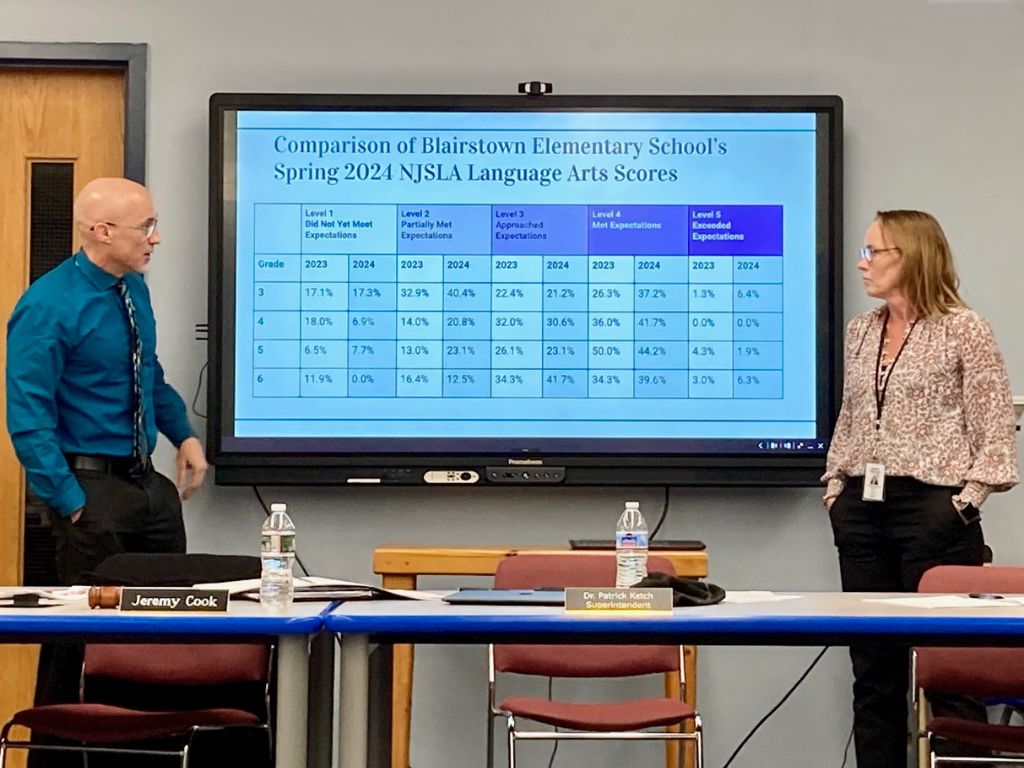
Ketch and Silvestri showed a comparison of ELA scores from spring 2023 to spring 2024. They pointed out instances of improvement by class cohorts. For instance, only 26.7% of the spring 2023 third grade met or exceeded expectations in ELA. This same cohort of students was in fourth grade in spring 2024, where 41.7% met or exceeded ELA expectations — an increase of 15%.
This pattern of intracohort improvement mostly held, with one exception: 54.3% of spring 2023’s fifth graders met or exceeded ELA expectations, but a year later, 45.9% of spring 2024’s sixth graders did likewise — a decrease of 8.4%.
Without the intracohort comparison, the data showed this percentage of students meeting or exceeding expectations in ELA:
Grade Three: 43.6% (16% increase vs. spring 2023) Note: Blairstown Elementary School’s numbers showed a 6.4% decrease here– numbers may have been displayed incorrectly on the slides.
Grade Four: 41.7% (5.7% increase vs. spring 2023)
Grade Five: 46.1% (8.2% decrease vs. spring 2023)
Grade Six: 45.9% (8.6% increase vs. spring 2023)
It’s a pretty positive report, with the exception of that significant drop in grade five.
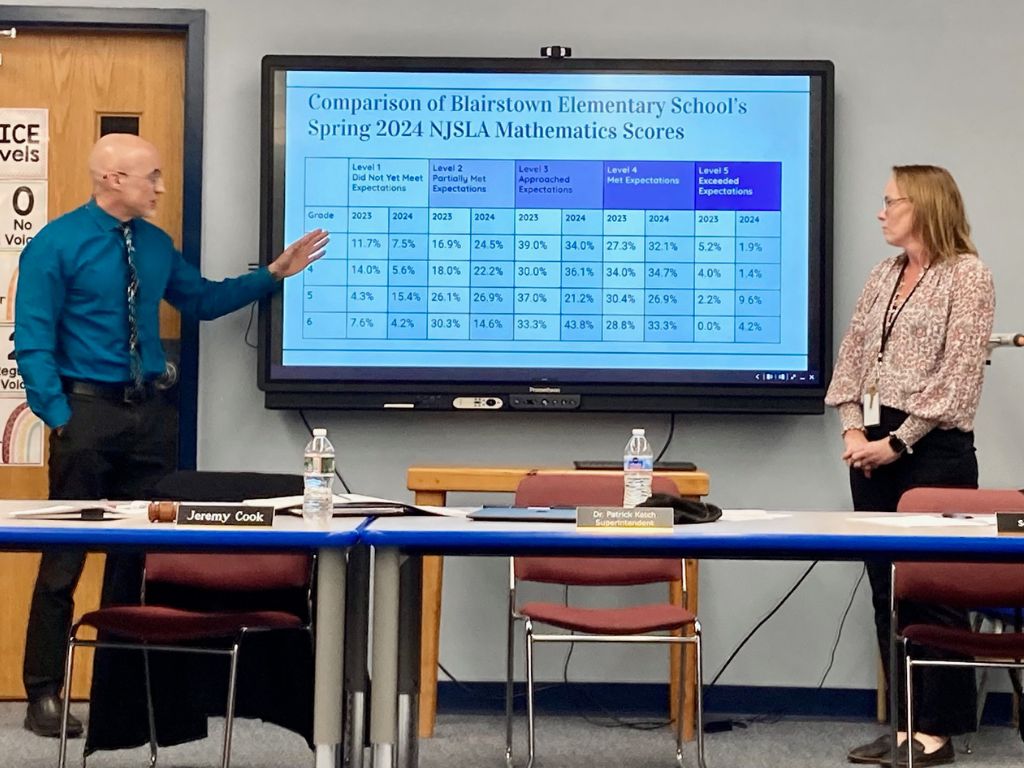
In math, the percentage of students meeting or exceeding expectations went like this:
Grade Three: 34% (increase of 1.5% vs. spring 2023)
Grade Four: 36.1% (decrease of 1.9% vs. spring 2023)
Grade Five: 35.6% (increase of 3.9% vs. spring 2023)
Grade Six: 37.5% (increase of 8.7% vs. spring 2023)
Changes compared to spring 2023 looked smaller in the math section, with the exception of a significant increase in grade six.
Staffing Issues May Have Contributed to Drops
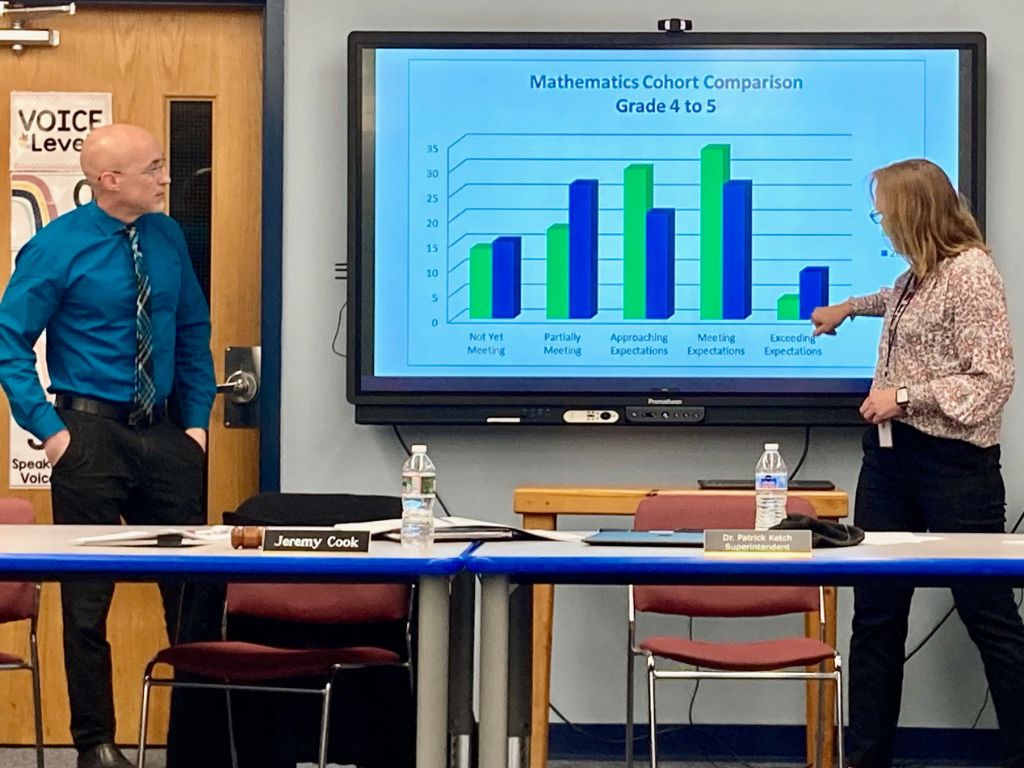
A breakdown by the five performance levels also showed that, while grade five beefed up the number of students achieving Level 5, the highest performance level, there were also considerable drops in Levels 3 and 4.
“We had some staffing difficulties with our fifth grade last year that, unfortunately, might have negatively impacted the students when it came to state testing,” Silvestri explained.
On the science test, 32.7% of grade five students met or exceeded expectations. This is a 6.7% increase compared to last year, on a test section that’s famously difficult — or, potentially, flawed. Case in point: in spring 2023, only 27% of New Jersey fifth graders met or exceeded expectations.
Blairstown Elementary Teachers Explain Strategies
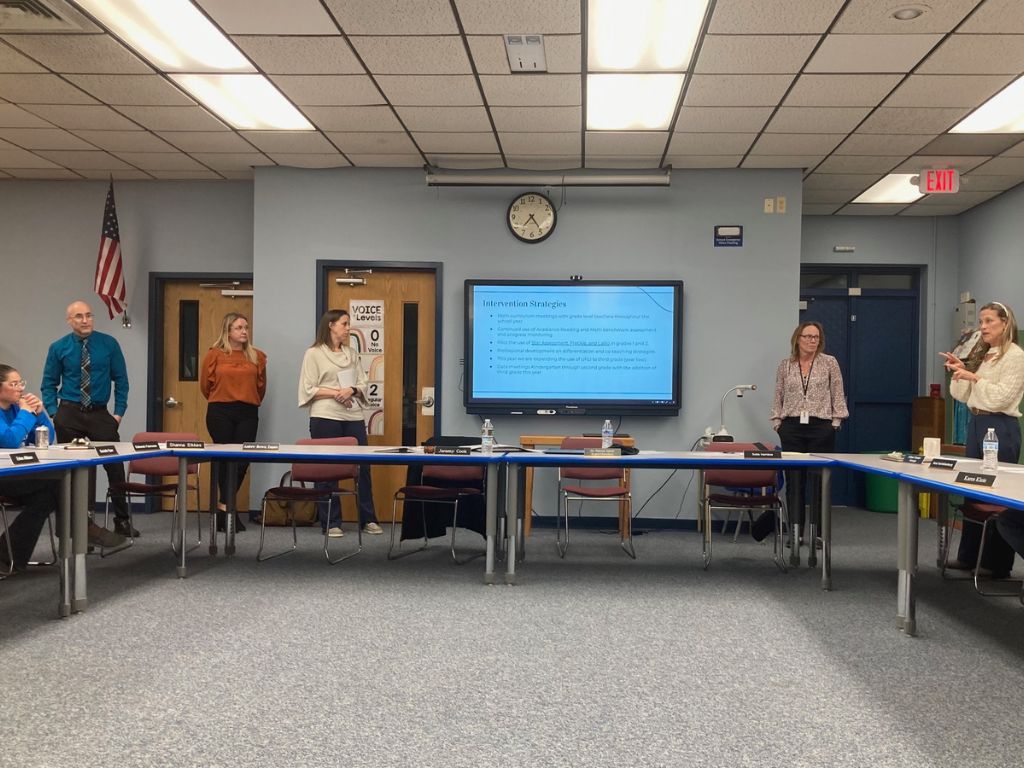
Silvestri and Ketch called up some of Blairstown’s teachers to explain what the school planned to do next. The teachers went over Blairstown’s plans to incorporate information from these results into their teaching. This includes the new math curriculum, which uses self-pacing to provide differentiated support and challenges to students according to their specific abilities, interactive reading tools and benchmark assessments from Acadience Learning, professional development and coaching for teachers, and resources from the University of Florida Literacy Initiative, which many teachers have found effective.
Board member Kevin Doell pointed out specific concerns with the drop in the fifth grade’s performance. Ketch reiterated staffing difficulties, which included a maternity leave and sick leave, a break in routine that may have affected student performance. Several teachers spoke to the strategies that they hoped to use to help last year’s fifth graders catch up.
Silvestri noted that even the most effective teaching strategies take time.
“It’s like going on a diet. Sometimes you have a [blip] in your diet, but as long as it’s the end of the year, and you’ve lost some weight, you’re doing a good job, and you’re consistent. And that’s what a lot of these programs are about. It’s the consistency.”
“We only went up 2 or 3% in exceeding or meeting,” Ketch added, “but it’s still a gain in the right direction.”
There was one another area of concern that came up at the meeting: absenteeism. School attendance has become an issue nationwide, with nearly a quarter of students qualifying as chronically absent in 2023, according to NPR.
To combat this growing problem, New Jersey has mandated that any district with an absenteeism rate above 10% must come up with a plan to address it, starting with a survey to parents. Blairstown’s absentee rate stands at 16.6%, so Blairstown Elementary families can expect a survey about school attendance soon.
Blairstown Elementary School’s next board of education meeting is scheduled for Dec. 12.

Chip O'Chang is an educator, fiction writer, and lifelong resident of New Jersey. He has also written for My Life Publications and NJ Indy. He lives in the NJ Skylands with his partner, two cats, and and a bearded dragon.
- Chip O'Chang, Contributing Writerhttps://ridgeviewecho.com/author/chip-ochang-contributing-writer/
- Chip O'Chang, Contributing Writerhttps://ridgeviewecho.com/author/chip-ochang-contributing-writer/

- Chip O'Chang, Contributing Writerhttps://ridgeviewecho.com/author/chip-ochang-contributing-writer/

- Chip O'Chang, Contributing Writerhttps://ridgeviewecho.com/author/chip-ochang-contributing-writer/

