

Main Street Hackettstown looks quieter than usual.
Nearly two weeks after Immigration and Customs Enforcement conducted its first large-scale enforcement operation in Hackettstown, residents, neighbors, and visitors are still processing the fallout.
For some local businesses, the operation has created some confusion as their Spanish-speaking clientele takes cover from ICE.
For other businesses, it’s just another day.
Fourteen Arrested in Morning Enforcement Operation
On Thursday, Aug. 6, at 7:15 a.m., the operation began.
ICE agents arrested several people outside Hackettstown’s Main Street businesses: Sunrise Dairy & Deli, Fruitimex Produce and the post office.
On Aug. 12, the Department of Homeland Security released an official statement that the operation had led to the arrest of 14 people, as first reported by WRNJ.
Two detainees were named. Both were alleged to have criminal records: Luis Rivera Guillen, said to have prior convictions in New York for criminal mischief with intent to damage property and possession of controlled substances and Rafael Salazar, “previously arrested on two occasions in Miami, Florida for cocaine possession.”
A search of Miami-Dade County’s criminal records found two cases concerning one felony charge of cocaine possession against a Rafael Salazar in March 2001. That charge resulted in a deferred disposition and referral to a drug program in lieu of a conviction.
All 14 Hackettstown detainees “are either in removal proceedings or in the process of being removed from the United States,” according to an ICE spokesperson via email.
Allegations of Quotas, Bounties, and Contracts With Private Security Firms
On Aug. 10, the activist groups Sussex Visibility Brigade and Project No Ice North Jersey Alliance (NINJA) posted a joint statement on Facebook that made several claims about the Hackettstown operation: that ICE had contracted a private security firm to assist with arrests; that contractors were told the operation would not end until 40 people had been arrested; and that contractors were paid $3,000 a day each for their assistance.
Guy Citron, a Hunterdon County Democrat and “concerned citizen,” had first heard of these allegations from a contact in Hackettstown who worked for an employee of a private security firm. The contact called Citron and relayed the allegations the morning of the raid.
As first reported by the Jersey Vindicator, Citron can’t prove the allegations. That difficulty is by design, he said.
“We are up against a $100-billion operation, and I’m just a guy with an a****** and two ears,” he said. “None of this is fair. We have this boot on our neck, and we’re trying to prove that it’s on our neck… It’s impossible because the boot will kick you while you’re down if you talk about it.”
The Ridge View Echo reached out to DHS with questions about the alleged presence of private security contractors, quotas, and bounties.
“There are no quotas for arrests,” the spokesperson replied via email.
In December 2025, an ICE agent identified as JB testified that his team was ordered to meet a target of eight daily arrests in Portland during “Operation Black Rose,” as reported by the Guardian.
The spokesperson also denied the use of private contractors. “Claims that ICE uses private contractors or ‘bounty hunters’ to make arrests are false. These type smears [sic] are designed to demonize and villainize our brave ICE law enforcement and is one of the reasons our enforcement officers face nearly 1,300% increase in the assaults against them.”
The second sentence is nearly identical to a DHS statement from June 2025 about a different allegation. “Any claims individuals have been ‘targeted’ by law enforcement because of their skin color are disgusting and categorically FALSE,” the June 2025 statement read. “These types of smears are designed to demonize and villainize our brave ICE law enforcement.”
Three months after that statement’s publication, a Supreme Court decision allowed ICE in Los Angeles to continue making arrests that used apparent ethnicity, among other factors, as grounds for reasonable suspicion.
Mayor and Town Council Hear Over an Hour of Public Comment
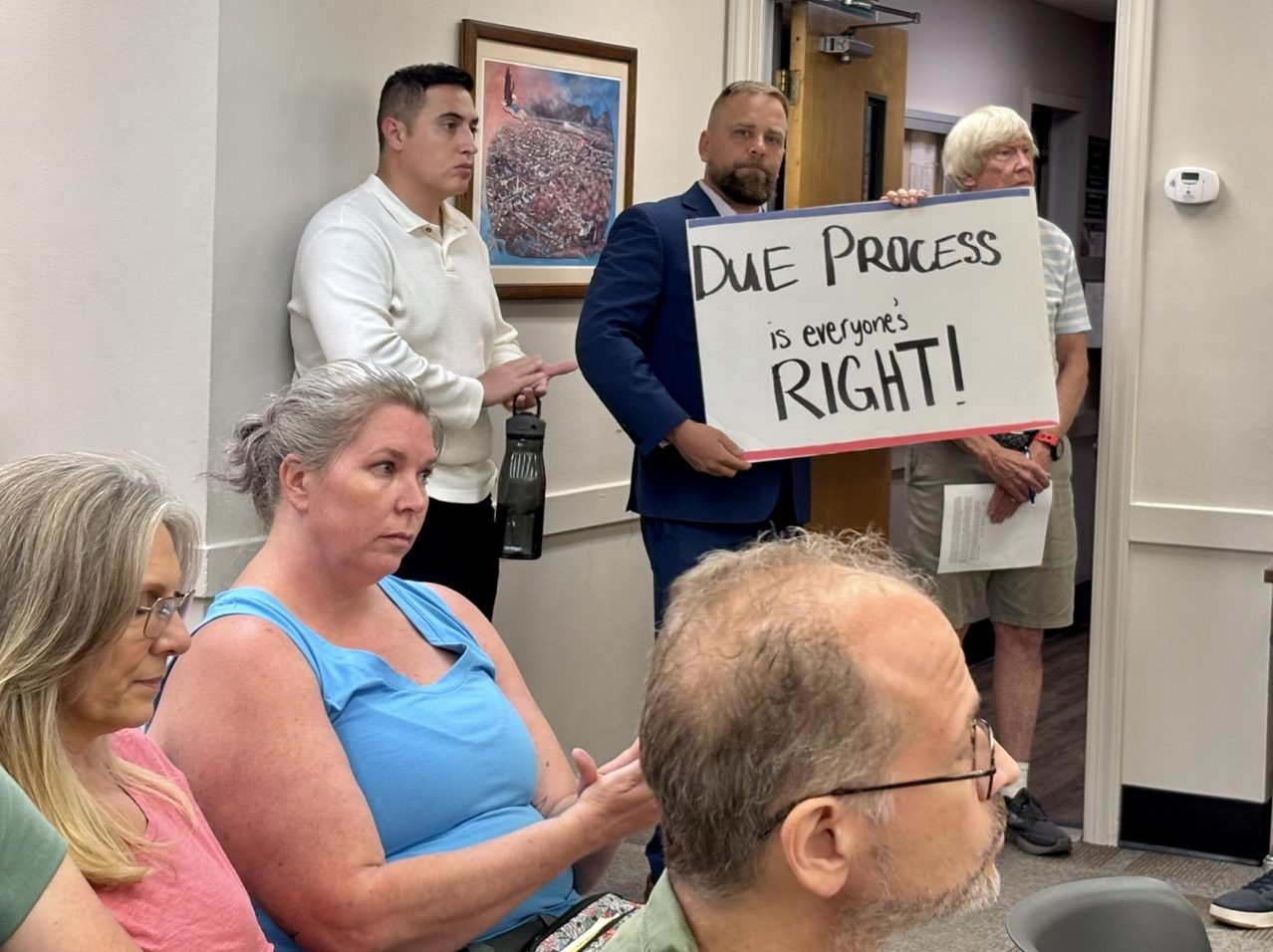
On Aug. 13, Hackettstown’s mayor and town council met for their regular meeting. The room was packed.
Public comment lasted an hour and 15 minutes.
One resident came to request assistance with an urgent gas line issue on his property. Every other speaker voiced concern about the ICE operation and hope that the council would take action.
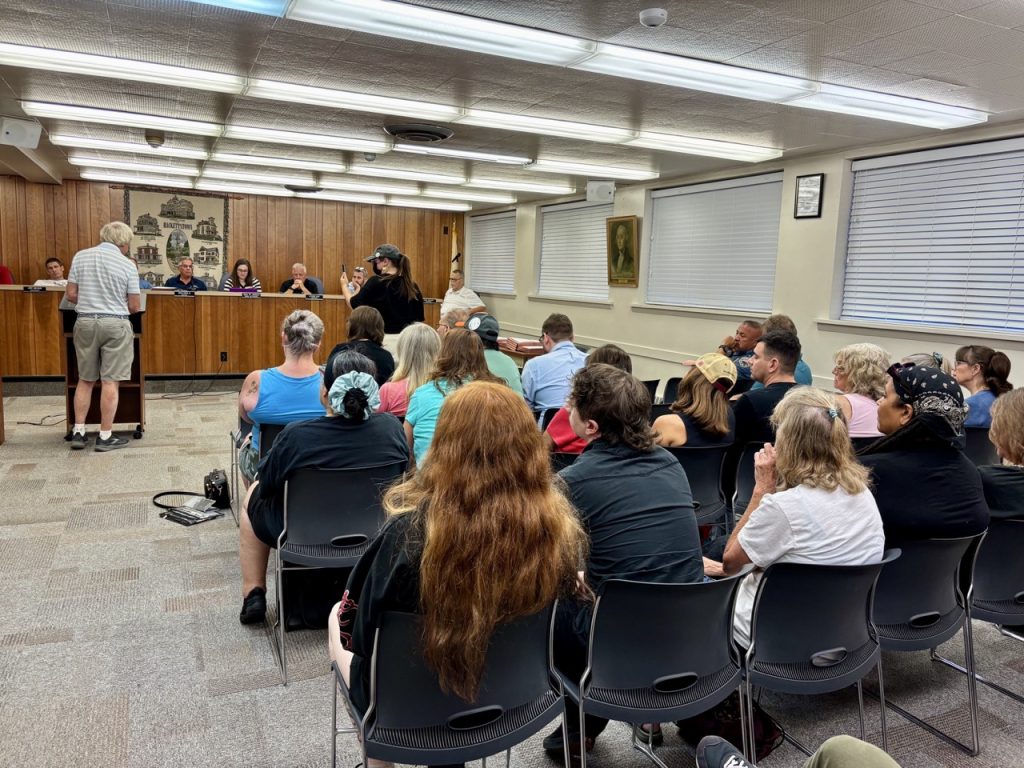
Members of the public discussed the large population of immigrants in Hackettstown, including many who have lived in the U.S. for decades; ICE’s “remarkably broad range of unlawful conduct,” in the words of William Angus from Mansfield; and residents’ and visitors’ fears for their own and their neighbors’ safety.
Several comments mentioned the case of Sebastian Pasco, a Hoboken bartender with a permanent resident card, commonly known as a green card. Despite his legal status and lack of criminal record, Pasco was arrested by ICE in May and held in custody for three months. He was released in early August.
Commenters pointed out the worrisome implications of the case for other ICE encounters and for the rule of law in general. “Regardless of how you feel, this is not justice. This is not due process,” said activist Birdie Green of Montague.
Mayor Jerry DiMaio and the town council pointed out the limitations of town officials and local law enforcement to act in the face of federal law. Council members also paid close attention to the residences of commenters, clarifying when people with Hackettstown mailing addresses technically paid taxes in different towns. Over an hour into the public comment period, council member Len Kunz remarked about one resident: “First one tonight from Hackettstown.”
At the same time, council members pushed back against accusations that they did not care or, as one meeting attendee asserted, that they looked bored.
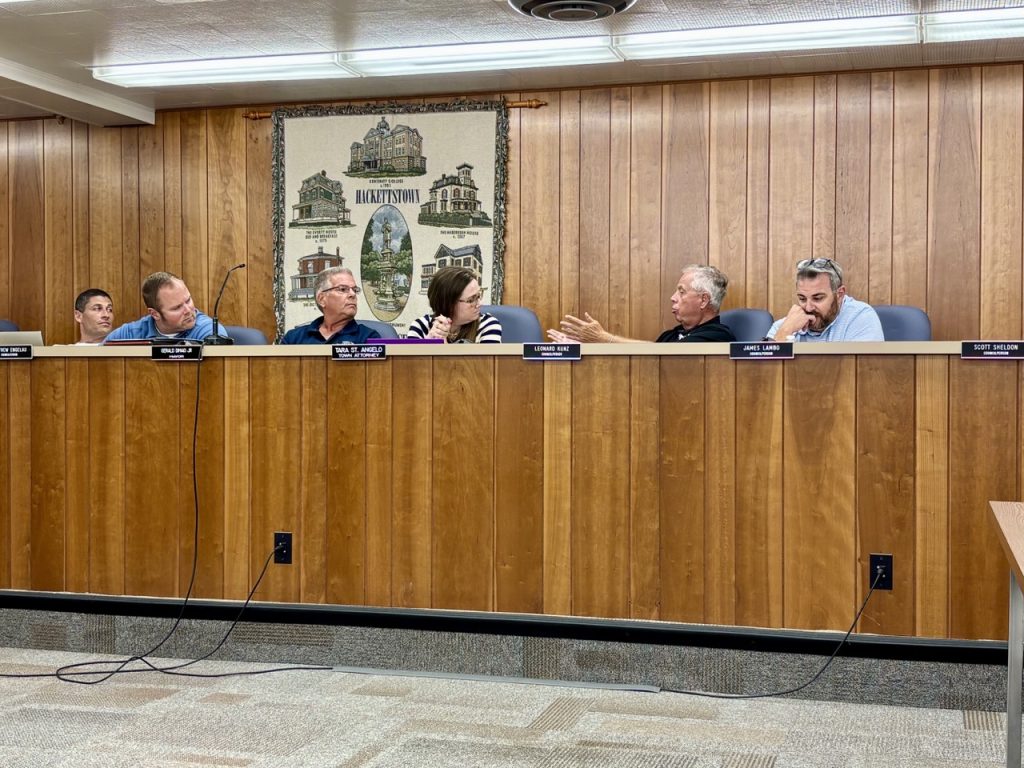
“We all want a safe community [where] we can live in peace,” Kunz said. “Every single one of us listened to everything that was said tonight, and we will do what we can.”
The council agreed to reach out to DHS for more information. No town representatives had been notified of the August 6 operation beforehand.
“Just so you know, this is a first for us, too,” Mayor DiMaio said. He urged commenters to reach out to their federal representatives with their concerns. The crowd responded collectively: “We have.”
The Views From Main Street
An August weekend would usually see a healthy crowd on Hackettstown’s sidewalks.
To Katherine, whose last name and workplace Ridge View Echo is withholding because of concerns about potential immigration-enforcement consequences, her neighborhood now looks like a ghost town.
Katherine works at a Main Street business that opened this past spring. Business was good until the ICE operation. Now, she estimates that her sales have been cut in half.
Nearly all of her customers are Spanish speakers. For them, the arrests are personal.
“Some of [the detainees] were customers, some of them were related to the customers,” Katherine said. “So you know, it made people scared. Even some of them that told me they do have papers, they’re scared either way.”
The business’s highly visible Main Street location, once an attraction for foot traffic, has now become a liability. Her customers are scared to approach, in case there are reports of ICE. Hackettstown’s Spanish-speaking community has created a whisper network to share ICE sightings via messaging apps, but fear remains high.
Katherine offers delivery, but money has tightened for her customers. “We were just thinking about, like, let’s sell this place,” she said. “Because to be honest, it’s too much stress…. How are you gonna buy more stuff, pay bills, and not sell anything?”
Another Main Street mainstay, Sunrise Dairy & Deli had been a gathering spot for Spanish-speaking day laborers in search of work. Now that gathering has scattered, and with it, work and disposable income.
Other Spanish-speaking workers on Main Street echoed the same observations: empty businesses, missed appointments, quiet streets.
It’s a different atmosphere for Bruno, owner of a Main Street restaurant, whose identity has also been withheld. His place is a destination spot, he said. Although he’s noticed the new quiet around town, it hasn’t affected his sales or operations.
Bruno is ambivalent about ICE. “They’re doing a job, and whether it’s right or wrong, I’m pretty neutral on that,” he said. “I have my mixed feelings about it.”
On the one hand, he’s seen how illegal immigrants have been the traditional backbone of the restaurant industry. Hurting them also hurts the restaurants that rely on their inexpensive labor. At the same time, he believes the quieter streets may feel safer to visiting families.
“I think it’s put a lot of these people that are illegal on alert, to keep an eye out,” he said. “But if they’re here illegally and doing something illegally, you know, I agree with it. If they’re here and they’re not hurting anybody, you know, I don’t agree with it.”
Joe Fisher, owner and head brewer of Man Skirt Brewing, feels ambivalence as well. “It’s hard to tease out what’s real and what’s not,” Fisher said.
He notes, “For example, with posts by a Spanish speaker who says in Spanish, ‘Hey, ICE is in town. Be careful.’ And the comment section is just overrun with, you know, ‘If you were legal, you’d have nothing to worry about.’ ‘No, ICE is doing such a great job.’ And like, are all of those bots? Are all of those townsfolk?”
Despite uncertainty and ambivalence, he has found one point of personal clarity.
“I have a lot of complicated feelings on the subject,” Fisher said. “But most of them boil down to: Even if we want to say that people should be in this country legally, having a masked force of unnamed people with guns rounding them up on the street feels like the most anti-American thing I could think of.”

Chip O'Chang is an educator, fiction writer, and lifelong resident of New Jersey. He has also written for My Life Publications and NJ Indy. He lives in the NJ Skylands with his partner, two cats, and and a bearded dragon.
- Chip O'Chang, Contributing Writerhttps://ridgeviewecho.com/author/chip-ochang-contributing-writer/

- Chip O'Chang, Contributing Writerhttps://ridgeviewecho.com/author/chip-ochang-contributing-writer/

- Chip O'Chang, Contributing Writerhttps://ridgeviewecho.com/author/chip-ochang-contributing-writer/

- Chip O'Chang, Contributing Writerhttps://ridgeviewecho.com/author/chip-ochang-contributing-writer/

