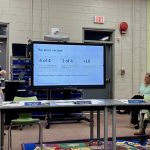
At Blairstown’s Oct. 16 Board of Education meeting, Superintendent Dr. Patrick Ketch and Principal Colleen Silvestri presented the school’s spring 2025 results from the New Jersey Student Learning Assessment (NJSLA). Administered every spring to students statewide, the test is meant to assess the progress of an entire school’s progress toward statewide learning outcomes.
Just like last year, Ketch and Silvestri structured their presentation by following cohorts of students from year to year. The goal was to show student growth by demonstrating how 2024’s third graders, for example, performed better on the test as 2025’s fourth graders.
However, also similar to last year, removing this structure and looking only at data comparing BES and the state average revealed a worrisome lag in Blairstown student performance.
Blairstown’s Report Card
The level of concern varies by grade level.
Grades 4 and 5 are Blairstown’s relative success stories this year. Both grades showed improvement over the performance of last year’s grades 4 and 5. In both ELA and math, the two grades came close to meeting state averages:
- BES Grade 4 English Language Arts: 51% meeting or exceeding expectations vs. 53.6% state average
- BES Grade 4 Math: 46% meeting or exceeding vs. 46.7% state average (less than a point’s difference)
- BES Grade 5 ELA: 47.3% meeting or exceeding vs. 52.7% state average
- BES Grade 5 Math: 43.3% meeting or exceeding vs. state’s 44.2%
Grade 6 demonstrated a K-shaped change in test scores compared to last year’s Grade 6. On the one hand, the percentage of sixth graders meeting or exceeding expectations grew two percentage points to 39.2%. This is less than a point below the state average of 39.8%.
At the same time, the number of low-scoring students spiked. In spring 2024, 18.8% of BES grade 6 students scored in the two lowest scoring categories of Not Meeting Expectations and Partially Meeting Expectations. In spring 2025, this number grew to 35.3%, nearly doubling.

The same pattern appears in Grade 6 ELA scores. In spring 2024, 12.5% of sixth graders scored in the two lowest categories on the ELA section. In spring 2025, that number doubled to 27.4%. The percentage of students meeting or exceeding expectations on the ELA section also dropped, lagging the state average by 15%.
The numbers suggest an educational version of the saying that the rich get richer and the poor get poorer. Here, the uneven educational progress in sixth grade shows the strong students getting stronger, especially in math, while struggling students are struggling harder.
Grade 3 Scores Lagging
The test results for Grade 3 tell a more consistent story, and a concerning one.
The number of Grade 3 students meeting or exceeding expectations in math is 26%. This is about half of the state average of 49.8% and a significant drop from last year’s Grade 3 math scores, when 34% of third graders met or exceeded expectations.
The situation is even worse in English Language Arts. Only 10% of third graders meet or exceed grade-level expectations on this section compared to the state average of 45%. Last year’s third graders at BES did twice as well, when 21% met or exceeded expectations.

Overall, last spring’s third graders demonstrated significant struggles on the test. Their scores lagged the state as well as Blairstown’s own performance in spring 2024.
The one certain bright spot is science. Only fifth graders take the science section of the NJSLA, and BES Grade 5 delivered: 37.9% of students met or exceeded expectations in science, surpassing the state average of 30.1%.
District Response to Concerns
The lagging scores come as a disappointment after the benchmark results released over the summer. These benchmarks, administered through the learning platform Acadience Learning, seemed to demonstrate progress in reading and math across grade levels.
Board member Kevin Doell reacted strongly to the third grade ELA numbers in particular. “Help me understand why I should not be really concerned about third graders, where, basically, according to that chart, 90% of third graders did not meet expectations,” he said.
Silvestri responded with strategies the staff had discussed in response to the test results: more reading instruction, working in smaller groups to provide better interventions, aligning pacing across classrooms to ensure consistency in the curriculum, more professional development for teachers, and more work on conflict resolution to prevent playground strife from creating classroom distraction.
She also mentioned the need to focus on specific skills required by the test that BES classrooms don’t currently focus on. For example, the NJSLA requires students to write extensive answers in response to reading passages, a task that the Blairstown curriculum hasn’t called for.
To address the concerns in sixth grade, teachers will look to incorporate more writing into science and social studies and more response to intervention (RTI) resources in math, which the school plans to distribute more efficiently this year.
At times, Silvestri mentioned factors like the possibility of students having bad days, or struggling with the transition from elementary to middle school curriculum, or the challenge of switching to a test medium that’s different from everyday school curriculum. Doell and others pointed out that these factors are commonly faced by all students, and they do not explain why BES students would struggle more than other students statewide.
Blairstown’s next Board of Education meeting will take place on Tuesday Nov. 18 at 7 p.m.

Chip O'Chang is an educator, fiction writer, and lifelong resident of New Jersey. He has also written for My Life Publications and NJ Indy. He lives in the NJ Skylands with his partner, two cats, and and a bearded dragon.
- Chip O'Chang, Contributing Writerhttps://ridgeviewecho.com/author/chip-ochang-contributing-writer/

- Chip O'Chang, Contributing Writerhttps://ridgeviewecho.com/author/chip-ochang-contributing-writer/

- Chip O'Chang, Contributing Writerhttps://ridgeviewecho.com/author/chip-ochang-contributing-writer/
- Chip O'Chang, Contributing Writerhttps://ridgeviewecho.com/author/chip-ochang-contributing-writer/