The stars of Blairstown Elementary’s Sept. 18 Board of Education meeting were the youngest people in the room.
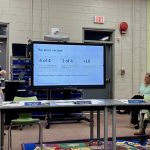
They were the leadership team of the Student Climate and Culture Committee at Blairstown Elementary School. Last year, the committee boasted 43 members — a record at the time. This year, it broke its own record with 58 total students participating.
As fifth grade teacher and faculty facilitator Tammy Messina said, that’s a good problem to have.
Messina introduced the four members of the committee’s leadership team who were able to attend the meeting: Clara Lovell, Willow Krasnick, Torre Bulger, and Maria Rifenbark.
“Our motto is serving others to change the world,” Messina said in her introduction. “So, if you want to change your world, start serving people.”
The committee’s BES Spirit Team Leader, Ella Griffin, could not attend the presentation in person but pre-recorded a statement for Messina to play.
Her remarks captured the committee’s motto in her own words: “Serving others goes beyond mere obligation. It’s about fostering connections that uplift and enrich lives.”
The presentation covered the committee’s activities from last year — an extensive list that included pep rallies, collections for homeless veterans, the Foodshed Alliance and food pantries, as well as anti-bullying plays, Earth Day cleanups and last spring’s Dial-a-Smile. With more members than ever, the committee hopes to continue and expand its efforts this year.
The board members heartily applauded the student leaders. “That was fantastic,” said Board President Jeremy Cook. “I believe in that. Service really makes a difference.”
During the public comment section at the end of the meeting, Blairstown resident Courtney Matash spoke about the state of pre-K at BES.
Over the summer, the Expanding Early Childhood Education Act passed into law. The new legislation mandates full-day kindergarten in all districts by 2030 and makes several changes to the state’s preschool expansion program, with the goal of expanding access to free pre-K across New Jersey.
BES was eligible for a grant to build its own state-funded pre-K program. Matash had previously asked the administration why the grant opportunity wasn’t pursued and wanted to know more.
Supervisor of Special Services Dr. Alyssa Emili gave several reasons. One obstacle, she said, was the need to hire more staff, since the program would have to operate six hours a day for all age levels. This could also require paraprofessionals to work full-time, increasing the cost of providing benefits.
Space was another concern, as an earlier version of the legislation required rooms of 950 square feet with a bathroom. Transportation was also a worry, both logistically and financially.
“It became a discussion on our part that it was significantly cost-prohibitive for us to move forward with that,” Emili said.
Matash pointed out that in July, the Expanding Early Childhood Education Act relaxed some of the requirements, including the square footage and bathroom requirements. She emphasized the importance of accessible early childhood education and its impact on the community, urging the board to continue exploring options.
Looking Ahead
This year, the NJSLA will changed to an adaptive test, with question difficulty adjusting to student performance to provide a more precise picture of ability. Like other schools across NJ, BES will take a field test of the new format later this fall, with the official assessment in the spring.
The next Board of Education meeting is scheduled for Oct. 16, when school staff will present the results of last spring’s NJSLA testing.

Chip O'Chang is an educator, fiction writer, and lifelong resident of New Jersey. He has also written for My Life Publications and NJ Indy. He lives in the NJ Skylands with his partner, two cats, and and a bearded dragon.
- Chip O'Chang, Contributing Writerhttps://ridgeviewecho.com/author/chip-ochang-contributing-writer/

- Chip O'Chang, Contributing Writerhttps://ridgeviewecho.com/author/chip-ochang-contributing-writer/

- Chip O'Chang, Contributing Writerhttps://ridgeviewecho.com/author/chip-ochang-contributing-writer/
- Chip O'Chang, Contributing Writerhttps://ridgeviewecho.com/author/chip-ochang-contributing-writer/